Modern Java development has changed dramatically in the last decade.
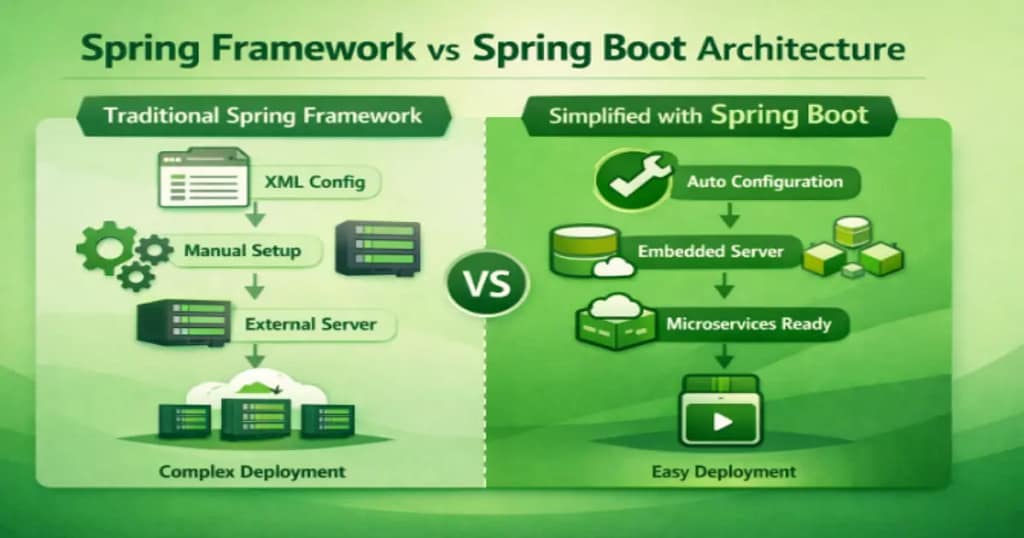
In the early days, developers spent hours configuring XML files, setting up application servers, and managing dependencies before even writing real business logic.
Then Spring Boot arrived and simplified everything.
But here’s where many developers get confused:
Spring Boot is not a replacement for Spring.
It’s actually built on top of the Spring Framework.
So the real question is not Spring vs Spring Boot.
The real question is
When should you use the Spring Framework, and when should you use Spring Boot?
In this guide, we’ll break down the 7 key differences, explain real use cases, and help you decide which one to choose in 2026 and beyond.
Summary: Spring vs Spring Boot
Spring Framework is the core Java framework used to build enterprise applications.
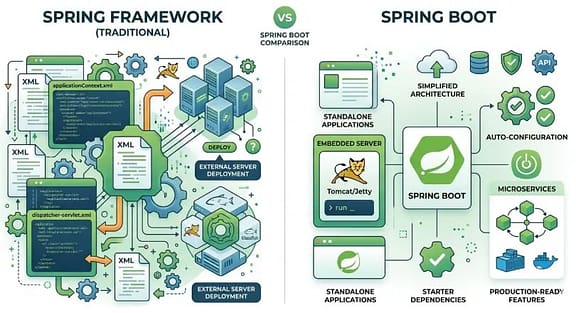
Spring Boot is a tool that simplifies Spring by providing auto-configuration and embedded servers.
Spring Boot reduces setup time and helps developers build applications faster.
Traditional Spring offers more configuration control but requires more manual setup.
For most modern applications in 2026, developers prefer Spring Boot.
What Is Spring Framework?
The Spring Framework is a powerful Java framework for building enterprise applications.
It provides core features such as the following:
Dependency Injection (DI)
Inversion of Control (IoC)
Aspect-Oriented Programming (AOP)
Transaction management
Integration with databases, messaging, and web frameworks
Developers traditionally used Spring with manual configuration, which required:
XML configuration files
Explicit dependency management
External application servers
Although powerful, this setup required significant configuration effort.
What Is Spring Boot?
Spring Boot is an extension of the Spring Framework designed to simplify application development.
It removes most manual configuration and allows developers to create production-ready applications quickly.
Key features include the following:
Auto-configuration
Embedded servers (Tomcat, Jetty)
Starter dependencies
Production-ready monitoring tools
With Spring Boot, you can run a full application using a single command.
Example: java -jar application. jar
This dramatically reduces setup time and improves developer productivity.
Important Clarification: Spring Boot IS Still Spring
A common misconception is that Spring Boot replaced Spring.
That’s not true.
Spring Boot simply automates configuration and provides sensible defaults for Spring applications.
Think of it like this:
| Technology | Purpose |
|---|---|
| Spring Framework | Core framework and infrastructure |
| Spring Boot | Tool that simplifies Spring configuration |
So when you use Spring Boot, you are still using the Spring Framework internally.
Spring Boot vs Spring Framework: Side-by-Side Comparison
| Feature | Spring Framework | Spring Boot |
|---|---|---|
| Configuration | Manual configuration required | Auto-configuration |
| Setup Time | Slower | Much faster |
| Server Requirement | External server needed | An embedded server included |
| Development Speed | Moderate | Very fast |
| Learning Curve | Higher | Beginner-friendly |
| Microservices Support | Possible but complex | Built specifically for microservices |
| Production Readiness | Needs extra setup | Built-in monitoring tools |
7 Key Differences Between Spring Boot and Spring Framework
1. Configuration Complexity
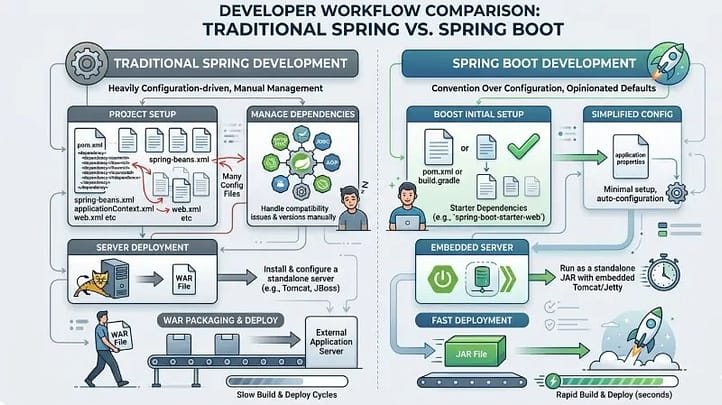
Traditional Spring applications require significant configuration.
Developers often write:
XML configuration files
Java configuration classes
Bean definitions
Spring Boot eliminates most of this using auto-configuration.
Spring Boot automatically configures components based on dependencies present in the project.
Result: Less boilerplate code and faster development.
2. Embedded Server Support
Spring applications typically require deployment on external servers such as the following:
Apache Tomcat
JBoss
WebLogic
Spring Boot includes embedded servers such as the following:
Tomcat
Jetty
Undertow
This means applications can run as standalone JAR files.
Benefits include:
Easier deployment
Faster development cycles
Simplified testing
3. Dependency Management
Managing dependencies in traditional Spring projects can be complex.
Developers must manually include libraries in build tools such as the following:
Maven
Gradle
Spring Boot simplifies this using starter dependencies.
Examples include:
spring-boot-starter-web
spring-boot-starter-data-jpa
spring-boot-starter-security
These starters automatically include required libraries.
4. Application Startup Speed
Spring Boot applications typically start faster because of the following:
Configuration is automated
Embedded servers eliminate server startup delays
Traditional Spring applications often require the following:
Server initialization
Manual configuration loading
This makes Spring Boot ideal for microservices architectures.
5. Microservices Development
Modern systems increasingly use microservices architecture.
Spring Boot was designed with this in mind.
It integrates easily with:
Spring Cloud
Docker
Kubernetes
This makes it a preferred choice for building scalable cloud-native applications.
Traditional Spring applications can support microservices, but setup is more complex.
6. Production Monitoring and Management
Spring Boot includes production-ready features via Spring Boot Actuator.
These tools provide endpoints for:
Application health monitoring
Metrics tracking
Environment information
Application performance
Traditional Spring applications require additional configuration to achieve the same capabilities.
7. Development Productivity
Spring Boot significantly improves developer productivity.
Developers can create applications quickly using tools such as the following:
Spring Initializr
Starter dependencies
Auto-configuration
This means teams can focus on business logic instead of infrastructure setup.
When Should You Use Spring Framework?
Using the core Spring Framework alone can make sense when:
You need complete control over configuration
Building highly customized enterprise systems
Working with legacy applications
Your organization already has a large Spring infrastructure
In these scenarios, manual configuration may be beneficial.
When Should You Use Spring Boot?
Spring Boot is ideal for most modern applications.
Use Spring Boot when:
Building REST APIs
Developing microservices
Creating cloud-native applications
You want fast development and deployment
For most new Java projects in 2026, Spring Boot is the preferred choice.
Many companies expect backend developers to know Spring Boot, especially for Java backend developer roles.
What to Learn After Spring Boot
Recommended order:
Spring Boot basics
Spring MVC
Spring Data JPA
Spring Security
Microservices with Spring Cloud
If you’re planning to become a backend developer, follow this Spring Boot roadmap for freshers to learn the technology step by step.
Real-World Example
Imagine you are building an e-commerce REST API.
Using traditional Spring would require the following:
Configuring MVC manually
Setting up Tomcat
Managing dependencies
With Spring Boot, you can create the same API in minutes using the following:
spring-boot-starter-webEmbedded Tomcat
Auto-configuration
This dramatically reduces development time.
After learning Spring Boot, building real Java backend projects is one of the best ways to improve your skills.
Key Takeaways
The Spring Framework is the core Java enterprise framework.
Spring Boot simplifies Spring application development.
Spring Boot removes most manual configuration.
It includes embedded servers and starter dependencies.
Spring Boot is ideal for microservices and modern cloud applications.
Traditional Spring is still useful for highly customized enterprise systems.
For most developers today, Spring Boot is the faster and more practical choice.
My Experience Working With Spring and Spring Boot
The first time I worked with the Spring Framework, I spent more time configuring things than actually writing application logic. Setting up XML files, configuring beans, and deploying to an external server felt like solving a puzzle before the real work even started. It worked well, but it definitely required patience.
Later, when I started using Spring Boot, the difference was noticeable almost immediately. Creating a simple REST API took minutes instead of hours. The embedded server meant I could run the application with a single command, which made testing and debugging much easier.
One situation I remember clearly was building a small internal tool. With traditional Spring, deployment required several setup steps. With Spring Boot, the team just shared the JAR file and ran it locally without extra configuration.
The biggest lesson for me was this: understanding the core Spring concepts first makes Spring Boot much easier to use and troubleshoot later.
FAQ (Frequently Asked Questions)
1. Is Spring Boot a replacement for the Spring Framework?
No, Spring Boot is not a replacement for the Spring Framework. It is an extension built on top of the Spring Framework that simplifies the process of creating and configuring Spring-based applications. Spring Boot provides features such as auto-configuration, starter dependencies, and embedded servers to reduce manual setup. Developers still use the core Spring Framework features internally when building applications with Spring Boot.
Source: Spring Documentation
Source: Wikipedia
2. What is the main difference between Spring Framework and Spring Boot?
The main difference lies in configuration and setup. The Spring Framework provides the core infrastructure for building Java enterprise applications, including dependency injection and modular architecture. Spring Boot simplifies the use of this framework by providing auto-configuration, starter dependencies, and built-in servers that allow applications to run with minimal setup. As a result, Spring Boot reduces the amount of manual configuration typically required in traditional Spring projects.
Source: TechTarget
Source: Wikipedia
3. Does Spring Boot require an external application server?
Spring Boot applications usually do not require an external application server because they include embedded servers such as Apache Tomcat or Jetty. This allows developers to package and run applications as standalone executable JAR files. In traditional Spring applications, developers typically deploy applications to an external server such as Tomcat or JBoss. However, it is still possible to configure Spring Boot to run with external servers if needed.
Source: Wikipedia
Source: Wikipedia
4. Can you use the Spring Framework without Spring Boot?
Yes, developers can use the Spring Framework without Spring Boot. The Spring Framework is a modular framework that allows developers to choose specific modules such as Spring MVC, Spring Data, or Spring Security based on project requirements. Many legacy or highly customized enterprise applications still use the core Spring Framework directly. However, modern projects often prefer Spring Boot because it reduces configuration complexity.
Source: Spring Documentation
Source: GeeksforGeeks
5. Is Spring Boot suitable for microservices architecture?
Spring Boot is commonly used for building microservices because it simplifies application setup and supports standalone deployment. It provides features such as embedded servers, auto-configuration, and integration with other Spring projects that make it easier to build REST APIs and distributed services. However, Spring Boot itself is not limited to microservices and can also be used for monolithic or web applications.
Source: Wikipedia
Source: GeeksforGeeks
External Authority References
For deeper technical documentation, readers can explore:
These official resources provide detailed technical documentation and updates.
If you’re completely new to Spring Boot, you can read our complete beginner guide to Spring Boot in Java to understand how it works step by step.
Discover more from GroWithMoney
Subscribe to get the latest posts sent to your email.