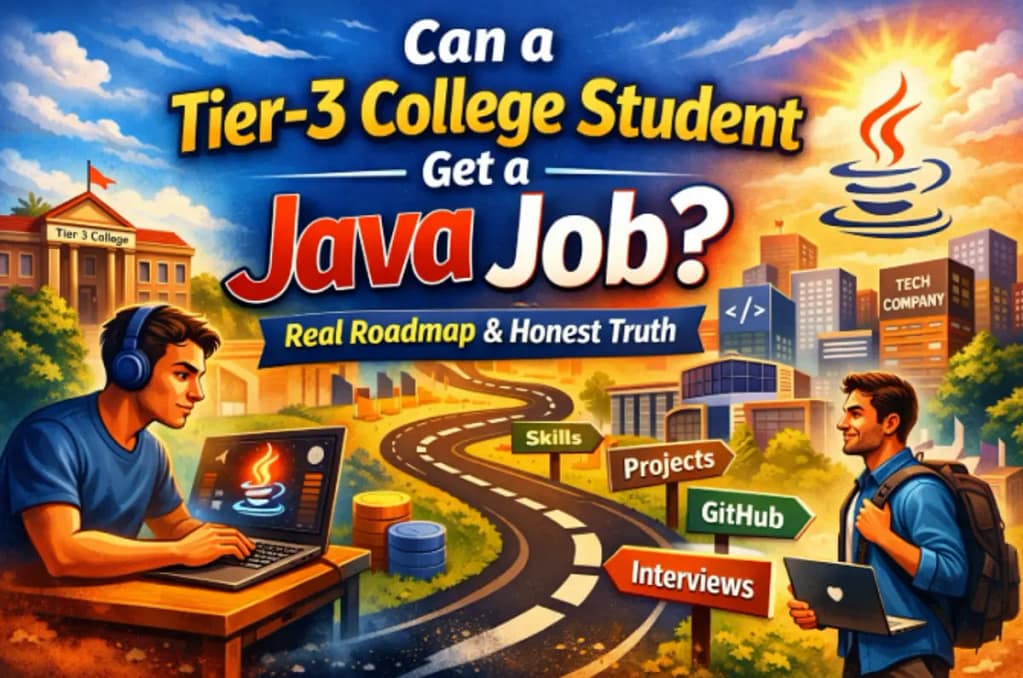
Last Updated on April 25, 2026 by Rex
If you are studying in a Tier-3 college, you’ve probably heard this sentence before:
“Top tech jobs only go to IIT, NIT, or Tier-1 graduates.”
And honestly, that belief scares a lot of students.
You scroll through LinkedIn, see people posting about jobs at FAANG companies, and start wondering:
“Do I even have a chance?”
Here’s the honest truth most career guides don’t tell you:
Yes — a Tier-3 college student can absolutely get a Java developer job.
But the path is different.
Companies rarely hire Tier-3 students based on college brand.
They hire them based on skills, projects, and proof of capability.
In fact, many backend developers working today started from unknown colleges, self-taught their skills, and built strong portfolios.
The difference is simple:
Average students rely on college placements.
Successful students build proof of skills.
This guide will show you:
The real hiring process for Java developers
Why Tier-3 students struggle
The exact roadmap to land a Java job
Skills companies actually look for
Mistakes most students make
If you follow this roadmap consistently, your college name becomes less important than your work.
Let’s start with the truth most students need to hear.
The Reality of Java Developer Job for Tier-3 College Students
Let’s be brutally honest.
Top tech companies do prefer Tier-1 campuses during placements.
Why?
Because campus hiring is about efficiency.
Recruiters visit institutes where they can interview hundreds of strong candidates quickly.
But this does NOT mean Tier-3 students are rejected.
Instead, companies hire them through:
Off-campus hiring
Referrals
Internships
Developer communities
GitHub portfolios
In fact, the tech industry cares more about skills than degrees compared to many other fields.
A strong developer from a small college can outperform someone from a top institute who never built real projects.
That’s why you see many developers from unknown colleges working in companies like:
product startups
SaaS companies
fintech companies
remote US startups
And many of these roles offer excellent salaries.
Can a Tier-3 College Student Get a Java Job?
Short answer:
Yes. But only if you play the game differently.
Let’s compare two students.
Student A (Typical Path)
Studies Java only for exams
Copies projects from GitHub
Waits for campus placements
Has no real portfolio
Result: Struggles to get interviews.
Student B (Smart Path)
Learns Java deeply
Builds real backend projects
Uploads work on GitHub
Writes technical blogs
Applies off-campus
Result: Gets interviews even without top college branding.
The difference is proof of skills.
Today’s hiring managers look for:
GitHub repositories
practical projects
problem-solving ability
backend development understanding
If you can demonstrate those, your college tier becomes far less important.
Why Companies Still Hire Java Developers in 2026

You might wonder:
Is Java still relevant?
Absolutely.
Java remains one of the most widely used programming languages in the world.
Large companies rely heavily on it for backend systems.
Common industries using Java:
Banking
FinTech
Enterprise SaaS
E-commerce
Cloud platforms
Telecom
Some major systems that rely on Java include:
payment processing systems
enterprise backend infrastructure
large-scale APIs
microservices architecture
This demand means companies continuously hire Java backend developers.
Another important reason:
Java developers often move into high-paying roles like:
Backend engineer
Cloud developer
Software engineer
Microservices architect
These roles typically have higher AdSense RPM keywords such as:
software engineer salary
backend developer salary
cloud developer salary
Java developer jobs USA
Which also makes this topic valuable for blog traffic.
Skills Required to Become a Java Developer
Many students think learning Java means simply knowing:
arrays
OOP concepts
But real companies expect much more.
A job-ready Java developer should understand multiple layers of backend development.
1. Core Java
Start with strong fundamentals.
Important topics:
OOP (Object Oriented Programming)
Collections framework
Exception handling
Multithreading
File handling
Streams API
Why this matters:
Interviewers test how well you understand Java internals.
2. Data Structures and Algorithms
You don’t need competitive programming mastery.
But you must know:
arrays
strings
hash maps
stacks
queues
linked lists
basic recursion
Focus on problem-solving clarity, not speed.
Platforms like:
LeetCode
HackerRank
CodeStudio
are commonly used for practice.
3. Spring Boot (Most Important Skill)
This is where many beginners fail.
Most backend Java jobs require Spring Boot.
It helps developers build:
REST APIs
microservices
backend servers
scalable applications
Spring Boot is essentially the industry standard framework for Java backend development.
If you learn this well, your chances of getting interviews increase significantly.
4. Database Knowledge
Every backend developer must know databases.
Important topics include:
SQL basics
MySQL or PostgreSQL
CRUD operations
database design basics
indexing basics
Most Java applications rely on relational databases.
5. Git and GitHub
Recruiters often check GitHub profiles.
A good GitHub shows:
clean code
multiple projects
commit history
documentation
This acts as public proof of your work.
The Tier-3 Advantage Most Students Ignore
Ironically, Tier-3 students sometimes have one hidden advantage.
Less academic pressure.
Students in top institutes often deal with:
heavy coursework
intense competition
constant academic pressure
Tier-3 students can use their time differently.
Instead of focusing only on grades, they can focus on:
building projects
freelancing
contributing to open source
learning real development tools
Many successful developers started this way.
They built real software instead of just completing assignments.
That difference becomes visible during interviews.
Step-by-Step Java Career Roadmap (Overview)

Here is a simplified roadmap most successful developers follow.
Java Roadmap for Freshers 2026: Step-by-Step Guide to Your First Dev Job: follow a complete Java roadmap for freshers
Phase 1 — Learn Java Basics (2–3 Months)
Focus on:
Java syntax
OOP concepts
simple programs
basic problem solving
Goal: Become comfortable writing Java code.
Phase 2 — Data Structures Basics (2 Months)
Practice coding problems regularly.
Focus on:
arrays
hash maps
strings
recursion
Goal: Improve logic building.
Phase 3 — Backend Development (3–4 Months)
Learn:
Spring Boot
REST APIs
authentication
database integration
Goal: Build real backend systems.
Phase 4 — Portfolio Projects (2 Months)
Create 3–4 real projects.
Examples:
task management API
blog backend system
e-commerce backend
URL shortener
Goal: Demonstrate real development capability.
Phase 5 — Apply Off-Campus
Start applying through:
LinkedIn
company career pages
referrals
developer communities
Consistency matters more than luck.
The Complete Java Developer Roadmap for Tier-3 College Students
Now that you understand the reality of tech hiring, let’s talk about the actual roadmap that works.
Many students make the mistake of learning too many technologies at once.
They try to learn:
Java
Python
JavaScript
Android
Machine learning
And end up mastering none of them.
A smarter approach is deep specialization first.
For a Java developer career, your roadmap should look like this:
Strong Java fundamentals
Data structures basics
Spring Boot backend development
Databases and APIs
Real portfolio projects
GitHub presence
Interview preparation
Let’s break this down step by step.
A one-page printable PDF Java_Roadmap_Freshers_2026
Step 1: Master Core Java (The Foundation)
Before touching frameworks like Spring Boot, you must understand how Java actually works.
Many students rush this stage and struggle later.
A strong Java foundation includes understanding:
Object-Oriented Programming
Java is built around OOP principles such as:
Classes and objects
Inheritance
Polymorphism
Encapsulation
Abstraction
Interviewers often ask practical questions like:
“Explain polymorphism with a real example.”
If you can explain concepts with real coding examples, it shows real understanding.
Important Core Java Topics
Focus on these areas carefully:
Collections framework
Multithreading basics
Exception handling
File handling
Java Streams API
Generics
These topics appear frequently in backend developer interviews.
Pro Tip
Don’t just read theory.
Practice by building small programs like:
file reader tools
mini calculators
student management systems
These help reinforce your understanding.
Step 2: Learn Data Structures the Practical Way
Many beginners believe they must solve 500 coding problems.
That’s not necessary for most developer roles.
Instead, focus on understanding common patterns.
Important data structures include:
Arrays
Strings
HashMaps
Stacks
Queues
Linked Lists
Trees (basic level)
You should also understand common algorithms such as:
sorting algorithms
searching techniques
recursion basics
The goal is not competitive programming.
The goal is problem-solving clarity.
Best Platforms for Practice
Some commonly used coding platforms include:
LeetCode
HackerRank
CodeChef
GeeksforGeeks practice problems
Practicing 2–3 problems daily is enough for consistent improvement.
Step 3: Learn Spring Boot (The Industry Standard)
This is the stage where your skills become job-ready.
Most modern Java backend applications use Spring Boot.
Spring Boot helps developers quickly create:
REST APIs
backend services
microservices
web applications
Instead of writing thousands of lines of configuration code, Spring Boot simplifies development.
Important Spring Boot Concepts
Focus on understanding:
Spring Boot architecture
REST API creation
dependency injection
MVC architecture
request and response handling
connecting databases
Once you understand these topics, you can start building real applications.
Step 4: Learn Databases and SQL
Backend development is impossible without databases.
A Java developer must know how to store and retrieve data efficiently.
Common databases used with Java include:
MySQL
PostgreSQL
MongoDB
But beginners should start with MySQL or PostgreSQL.
Important Database Skills
Focus on learning:
SQL queries
CRUD operations
joins
indexing basics
database schema design
For example, if you build a blog application, you should know how to design tables like:
users
posts
comments
This shows recruiters you understand real backend systems.
Step 5: Build Real Java Projects
This is the most important step.
Many students know theory but cannot build real software.
Recruiters quickly identify this.
Your portfolio should contain at least 3 strong backend projects.
Java Developer Portfolio Projects That Get You Hired in 2026 best Java portfolio projects that impress recruiters
Best Java Projects That Impress Recruiters
Here are some projects that demonstrate real skills.
1. Task Management API
A simple backend system where users can:
create tasks
update tasks
mark tasks complete
delete tasks
Skills demonstrated:
REST APIs
database integration
authentication basics
2. Blog Backend System
Create a backend for a blogging platform.
Features may include:
user registration
login system
create blog posts
comments
likes
Skills demonstrated:
authentication
REST APIs
database relationships
3. E-Commerce Backend
This is a slightly advanced project.
Features include:
product listing
shopping cart
order management
payment logic simulation
Skills demonstrated:
API design
database schema design
business logic implementation
4. URL Shortener
A popular backend project.
It converts long URLs into short links.
Skills demonstrated:
hashing
database lookups
scalable system thinking
Why Projects Matter
Projects prove three important things:
You can build real software
You understand backend architecture
You can solve practical problems
A strong project portfolio often matters more than college reputation.
Step 6: Build a Strong GitHub Profile

Many recruiters check GitHub profiles before scheduling interviews.
Your GitHub profile should show:
clean project repositories
proper documentation
meaningful commit history
project descriptions
Each project should include:
README file
explanation of features
setup instructions
screenshots or API documentation
This makes your profile look professional and credible.
Step 7: Start Applying Off-Campus
Waiting for campus placements can limit opportunities.
Instead, start applying through multiple channels.
LinkedIn Job Search
LinkedIn is one of the best platforms for developer jobs.
Search for keywords like:
Junior Java Developer
Backend Developer
Software Engineer Java
Apply consistently.
Company Career Pages
Many companies hire directly from their websites.
Search for career pages of:
startups
SaaS companies
fintech companies
These companies often hire skills-first candidates.
Developer Communities
Many job opportunities come from communities such as:
Discord developer groups
tech forums
open-source communities
Networking often leads to referrals.
Tools Every Java Developer Should Learn
Besides programming, developers must know certain tools.
These tools are commonly used in real projects.
Git
Git helps developers track code changes.
Important commands include:
commit
push
pull
merge
Version control knowledge is essential for team collaboration.
Docker (Basic Understanding)
Docker helps package applications into containers.
Many companies use Docker to deploy applications consistently.
Even basic understanding gives you an advantage.
API Testing Tools
Developers often use tools like:
Postman
Insomnia
These help test backend APIs during development.
Java Programming Category Page explore more Java programming guides
Realistic Timeline to Become Job Ready
Many beginners ask:
“How long does it take to become a Java developer?”
If you study consistently, the timeline looks like this:
| Phase | Duration |
|---|---|
| Core Java | 2–3 months |
| Data Structures | 2 months |
| Spring Boot | 3 months |
| Projects | 2 months |
| Interview prep | 1–2 months |
Total time: 8–10 months
This assumes daily focused learning.
Some students do it faster, but consistency matters more than speed.
Important Insight Most Students Miss
Companies rarely hire developers who only watch tutorials.
They hire developers who build things.
So the best learning approach is:
Learn → Build → Improve → Repeat
If you repeat this cycle, your skills will grow much faster.
Common Mistakes Tier-3 College Students Make
Many students from Tier-3 colleges are capable of becoming excellent developers.
But certain mistakes slow them down.
Understanding these mistakes can save months of wasted effort.
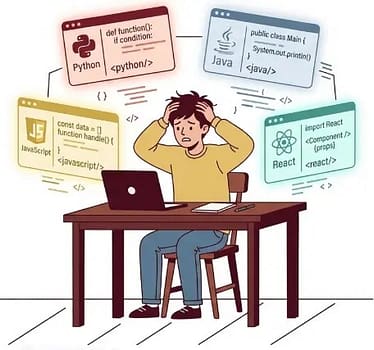
1. Learning Too Many Technologies at Once
This is one of the biggest mistakes beginners make.
They try to learn:
Java
Python
JavaScript
React
Machine Learning
Android Development
All at the same time.
The result?
They become confused beginners in many things instead of experts in one thing.
A better approach is focus and depth.
If your goal is a Java developer job, prioritize:
Core Java
Spring Boot
Databases
Backend projects
Once you are job-ready, you can expand your tech stack.
2. Watching Tutorials Without Building Projects
Many students spend months watching:
YouTube tutorials
online courses
coding bootcamps
But they never build real applications.
This creates tutorial dependency.
When asked to build something from scratch, they struggle.
The best learning formula is:
Learn → Build → Debug → Improve
Building projects forces you to solve real problems.
That’s where real learning happens.
3. Ignoring GitHub
Your GitHub profile is like a public resume for developers.
But many students either:
never upload projects
upload copied projects
leave repositories without documentation
A strong GitHub profile should show:
consistent commits
original projects
readable code
proper documentation
Recruiters often review GitHub before scheduling interviews.
4. Waiting Only for Campus Placements
Tier-3 college placements are often limited.
Some colleges invite only a few companies.
If you depend only on campus hiring, opportunities become restricted.
Instead, you should also apply through:
LinkedIn job listings
startup hiring platforms
company career pages
referrals from developer communities
The tech industry offers many off-campus opportunities.
5. Poor Resume Strategy
Many resumes look like this:
long objective statements
irrelevant academic projects
no technical depth
Recruiters typically spend less than 10 seconds reviewing resumes.
Your resume should clearly show:
programming skills
backend technologies
project links
GitHub profile
A clean and focused resume improves interview chances.
How to Prepare for Java Developer Interviews
Once your skills and projects are ready, the next step is interview preparation.
Most Java developer interviews test three main areas.
1. Java Fundamentals
Expect questions related to:
OOP concepts
collections framework
exception handling
multithreading basics
Interviewers often test your ability to explain concepts clearly with examples.
For instance:
“What is the difference between HashMap and HashTable?”
Understanding such topics shows strong fundamentals.
2. Data Structures
Coding questions may include:
array manipulation
string problems
hash map usage
simple recursion
You do not need advanced competitive programming skills.
But you must demonstrate logical thinking.
3. Backend Development Knowledge
If you claim Spring Boot experience, interviewers may ask about:
REST APIs
HTTP request methods
authentication concepts
database connections
They may also ask about the projects you built.
So be prepared to explain:
how your project works
architecture decisions
challenges you solved
Resume Strategy That Gets Interviews
Your resume should highlight proof of skills quickly.
Here is a simple structure that works well.
Header
Include:
name
email
LinkedIn profile
GitHub profile
Skills Section
Mention technologies clearly:
Java
Spring Boot
REST APIs
SQL
Git
Avoid listing too many technologies you barely know.
Projects Section
This is the most important section.
For each project mention:
project name
technologies used
features implemented
GitHub link
Example:
Task Management API
Built REST API using Spring Boot
Implemented CRUD operations with MySQL
Added authentication and user roles
This quickly communicates real development experience.
Salary Expectations for Java Developers
One question many students have is:
“What salary can a beginner Java developer expect?”
The answer depends on factors like:
skills
projects
company type
location
But we can look at general ranges.
Entry-Level Java Developer Salary (India)
Typical ranges for freshers:
₹4 LPA – ₹8 LPA in service companies
₹6 LPA – ₹12 LPA in product startups
Strong developers with good portfolios sometimes secure higher offers.
Entry-Level Java Developer Salary (United States)
For junior developers in the US market:
$70,000 – $100,000 per year in many companies
Remote startups may also hire developers globally.
These salary-related topics also attract high-CPC search traffic.
Pro Tips for Tier-3 College Students
Here are some strategies that dramatically improve your chances of success.
Build in Public
Share your learning journey on platforms like:
LinkedIn
Twitter/X
developer communities
Posting about projects can attract:
recruiters
collaborators
mentors
Many developers receive job opportunities through visibility.
Contribute to Open Source
Open-source contributions demonstrate:
collaboration skills
real development experience
code quality standards
Even small contributions improve credibility.
Learn Basic Cloud Concepts
Modern backend development often uses cloud platforms.
Basic knowledge of:
cloud deployment
containerization
CI/CD pipelines
can give you a competitive advantage.
Network with Developers
Many jobs are filled through referrals.
Join communities where developers discuss:
projects
technologies
hiring opportunities
Networking can open doors that resumes cannot.
8 Best Free AI Tools for College Students in 2026 (Study Smarter) free AI tools that help college students learn faster
Skills and Importance
| Skill | Importance |
|---|---|
| Core Java | High |
| Data Structures | High |
| Spring Boot | Very High |
| Git | Medium |
| Docker | Medium |
Tier 1 and Tier 3 Student Comparison
| Factor | Tier-1 Student | Tier-3 Student |
|---|---|---|
| Campus Hiring | Easy | Limited |
| Off-Campus | Possible | Must focus here |
| GitHub Portfolio | Optional | Essential |
| Skills Weight | Medium | Very High |
Frequently Asked Questions (FAQ)
What projects should a beginner Java developer build?
Good beginner projects include:
Task management APIs
Blog backend systems
URL shorteners
E-commerce backend applications
These demonstrate practical backend development skills.
Do I need to learn competitive programming for Java jobs?
Not necessarily. Basic knowledge of data structures and problem-solving is enough for many developer roles.
My Experience
I’ll be honest — when I first started learning Java, I thought watching tutorials counted as “learning.” I had three courses bookmarked, two YouTube playlists running, and zero projects built. Classic mistake.
The turning point came when I forced myself to build a simple Task Management API. It broke constantly. I Googled the same Spring Boot error probably eleven times. But somewhere between fixing those errors, I actually understood what I was building.
That’s something no tutorial ever gave me.
I also learned that waiting around for campus placements is basically hoping someone knocks on your door while you’re asleep. The moment I started applying off-campus — LinkedIn, startup career pages, developer communities — things actually moved.
Your GitHub profile matters more than you’d expect. Recruiters do check. An empty profile with copied projects quietly kills your chances before you even get a callback.
Build things. Break things. Push to GitHub. Repeat.
References & External Resources
Final Thoughts
If you are studying in a Tier-3 college, it’s easy to feel disadvantaged.
But the tech industry has something unique:
Skills can outperform credentials.
A developer who builds real software, solves real problems, and keeps learning will always find opportunities.
The key is simple but powerful:
Learn deeply
Build real projects
Share your work
Apply consistently
Do this long enough, and your college tier becomes just a small detail in your story.
Share this:

Discover more from GroWithMoney
Subscribe to get the latest posts sent to your email.