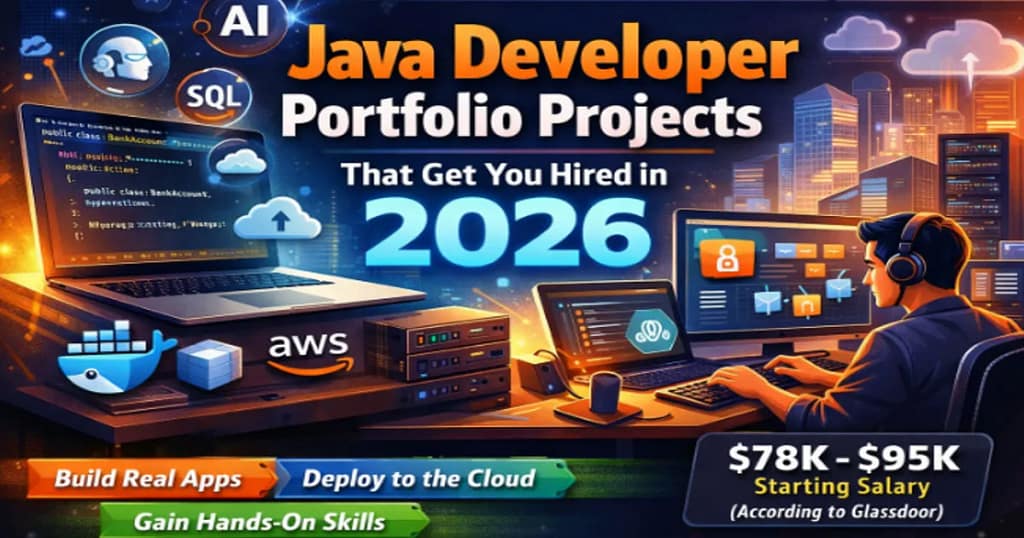
Breaking into tech without experience feels brutal.
You open job boards and see:
- “2+ years required.”
- “Spring Boot + AWS + Microservices”
- “Production experience preferred.”
And you’re thinking, I just learned what a HashMap is.
Here’s the shift most beginners miss:
Companies don’t hire experience.
They require evidence of capability.
This guide focuses on a smarter, longer-tail strategy:
“Java developer portfolio projects that get you hired 2026”
Not generic advice.
Not tutorial fluff.
But what actually moves interviews in today’s market?
(Free interactive checklist included at the Middle of this guide)
The Reality of the Java Job Market in 2026 (With Data)
Java is not dead. It is deeply embedded in enterprise systems.
According to the official platform documentation at Oracle, Java continues to power large-scale enterprise applications globally.
Now let’s look at market signals:
- On LinkedIn, Java consistently appears among the top backend job requirements in the U.S.
- Indeed regularly lists tens of thousands of Java-related openings across backend, fintech, and enterprise roles.
- The U.S. Bureau of Labor Statistics projects ~25% growth for software developers (much faster than average) through the decade.
- Salary surveys from Glassdoor show:
- Entry-level Java Developer (U.S.): $75,000–$95,000/year
- Junior Backend Developer: $80,000+ in major cities
Java remains dominant in:
- Banking
- Healthcare systems
- Enterprise SaaS
- Government IT
- Large backend systems
The opportunity is real.
The competition is real too.
A Realistic Case Study: Arjun’s 5-Month Transition

Let’s make this practical.
Arjun (fictional but realistic case)
Age: 23
Degree: B.Com (Non-CS)
Location: Dallas
Starting point: Basic Java from YouTube
He applied to 120 jobs.
Zero responses.
What changed?
Instead of “learning more tutorials,” he:
- Built a Banking Transaction Simulator API
- Deployed it to AWS free tier
- Added Docker support
- Documented architecture in README
- Added API documentation
Within 6 weeks:
- 4 interview calls
- 1 technical test
- 1 offer (Junior Backend Developer)
What did recruiters say?
“Your project looks like something used internally at a company.”
That’s the difference.
What Recruiters Actually Look For in 2026
Not:
- 50 half-done projects
- Random calculator apps
- Course completion certificates
But:
- Clean GitHub
- Realistic backend systems
- Database knowledge
- Cloud awareness
- Docker familiarity
- Basic AI tool usage
Let’s break this down properly.
Step 1: Master Core Java (With Concrete Proof)
Most beginners rush to frameworks.
Big mistake.
You must understand:
- OOP (Encapsulation, Polymorphism, Abstraction)
- Collections (ArrayList, HashMap)
- Exception handling
- Multithreading basics
- Streams & Lambdas
Concrete Example
Instead of just saying you know OOP, implement something meaningful:
public class BankAccount {
    private double balance;

    public BankAccount(double balance) {
        this.balance = balance;
    }

    public synchronized void deposit(double amount) {
        balance += amount;
    }

    public synchronized void withdraw(double amount) {
        if(amount <= balance) {
            balance -= amount;
        }
    }

    public double getBalance() {
        return balance;
    }
}
This shows:
- Encapsulation
- Thread safety
- Business logic
That’s stronger than “Completed Java course.”
Official reference documentation is maintained by Oracle.
Step 2: Spring Boot (Because 80% of Listings Require It)
Search “entry-level Java developer” on LinkedIn and you’ll see:
- Spring Boot
- REST APIs
- JPA
- SQL
Spring Boot project example:
@RestController
@RequestMapping("/employees")
public class EmployeeController {

    @GetMapping
    public List<Employee> getAllEmployees() {
        return employeeService.getAll();
    }

    @PostMapping
    public Employee addEmployee(@RequestBody Employee employee) {
        return employeeService.save(employee);
    }
}
This demonstrates:
- REST endpoint creation
- MVC structure
- JSON handling
Official framework documentation is available via VMware (Spring maintainers).
Step 3: Docker (Missing Skill in Most Beginner Portfolios)
Here’s where you stand out.
Many juniors ignore Docker.
But job listings increasingly mention the following:
- Containerization
- Deployment
- DevOps awareness
Add a Simple Dockerfile
FROM openjdk:17
COPY target/app.jar app.jar
ENTRYPOINT ["java","-jar","/app.jar"]
Now your project is:
- Portable
- Production-aware
- Deployable anywhere
Recruiters love this.
Step 4: Cloud Basics (AWS or GCP)
You don’t need advanced DevOps.
But you should know:
- What is EC2?
- What is S3?
- What is RDS?
- What is IAM?
Deploy one project to AWS Free Tier.
Add this to your resume:
“Deployed Spring Boot application on AWS EC2 with RDS MySQL integration.”
That line alone increases callbacks.
Step 5: AI Tools (Yes, This Is Now Expected)
In 2026, ignoring AI is a red flag.
Companies expect developers to:
- Use AI for debugging
- Generate test cases
- Improve productivity
Example:
Use AI to:
- Generate unit tests
- Refactor code
- Optimize SQL queries
But here’s the key:
You must understand the output.
AI is an assistant.
Not a substitute for knowledge.
Step 6: SQL (Where Many Juniors Fail)
Instead of saying “Know MySQL,” show something concrete:
SELECT customer_id, SUM(amount) as total_spent
FROM transactions
GROUP BY customer_id
HAVING SUM(amount) > 1000;
This proves:
- Aggregation
- GROUP BY
- HAVING
- Business logic
Recruiters test this frequently.
Before building projects, follow a complete Java developer roadmap for 2026 to avoid learning random topics.
5 Java developer portfolio projects that get you hired

Not toy projects.
1. Banking Transaction Simulator
- Multi-user accounts
- Transaction history
- ACID compliance
- Role-based authentication
2. E-Commerce Backend
- Cart logic
- Order processing
- Payment simulation
- Inventory management
3. URL Shortener (Production Style)
- Hashing logic
- Database storage
- Expiry support
4. Blog API With JWT Authentication
- Secure login
- Token validation
- Role management
5. Microservice Mini System
- 2 small services
- REST communication
- Dockerized setup
Each should include:
- README with architecture diagram
- Screenshots or API docs
- Deployment link
If you’re confused where to start, these practical Java projects for freshers can give you direction.
Common Beginner Mistakes (That Kill Interviews)
1. Tutorial Addiction
Watching 100 hours ≠ job-ready.
2. No Deployment
If your app only runs locally, it’s incomplete.
3. No Version Control
Use Git properly. Recruiters check commit history.
4. Overengineering
You don’t need Kubernetes.
Sample Java Portfolio Project Structure
One of the biggest mistakes freshers make is building a project… but presenting it poorly.
Here’s a clean structure that works in real interviews:
Recommended Folder Structure
-src/
-controller/
-service/
-repository/
-model/
-config/
-pom.xml
Keep it standard. Recruiters don’t like chaos.
README Template (Copy This)
Project Title
Short 1-line description of what the project does.
Tech Stack:
Java, Spring Boot, MySQL, JWT, Maven
Features:
User authentication
CRUD operations
Role-based access
REST API endpoints
How to Run:
Clone repo
Configure DB
Run
mvn spring-boot:run
Live Demo (if deployed):
Add link here.
How to Explain This in Interview (3-Line Script)
“I built this REST API using Spring Boot. It handles user authentication using JWT and stores data in MySQL. I focused on clean architecture and separated controller, service, and repository layers for maintainability.”
30–45 Day Java Portfolio Roadmap
This removes confusion. Follow this exactly.
Week 1–2:
Core Java revision
OOP concepts
Collections framework
Basic DSA practice
Week 3:
Learn Spring Boot basics
Build simple CRUD API
Connect MySQL database
Week 4:
Add authentication (JWT)
Add validation & exception handling
Improve project structure
Week 5:
Push clean commits to GitHub
Write proper README
Deploy project (Railway / Render / etc.)
Update resume
After 30–45 days, you will have:
1 strong backend project
Clean GitHub profile
Interview-ready explanation
That’s enough to start applying.
Reading this guide is step one.
Execution is everything else.
Use this checklist to track your exact progress — java-portfolio-checklist-2026
from core Java fundamentals to your first mock interview.
Check off each milestone as you complete it.
Resume Strategy That Works in 2026
Instead of:
“Passionate Java developer seeking opportunity…”
Write:
Banking Transaction Simulator API
- Built using Spring Boot + MySQL
- Implemented transaction locking with synchronized methods
- Dockerized application
- Deployed on AWS EC2
- Designed REST endpoints with exception handling
Technical. Specific. Concrete.
Many candidates struggle because they don’t understand why Java freshers fail interviews even after learning basics.
How Long Does This Actually Take?
Realistic timeline:
- 3–4 months (2–3 hrs daily): Job-ready
- 5–6 months (slow pace): Competitive
Consistency matters more than intensity.
Salary & Market Reality (From What I’ve Seen Firsthand)
When I first decided to go after a Java developer role with no experience, I honestly thought finishing a few tutorials would be enough. It wasn’t. I built small projects, but the first time I tried explaining them in an interview, I realized I didn’t truly understand my own code. That was a wake-up call.
I went back and rebuilt one project from scratch without looking at the solution. It was painful. I broke things. I Googled errors for hours. But that’s when things started clicking.
Another lesson? Recruiters don’t care how many courses you completed. They care whether you can solve real problems. Once I started focusing on clean code, proper Git commits, and documenting what I built, responses improved.
The biggest shift came when I stopped trying to “look experienced” and started actually practicing like a developer. That confidence shows. And yes, debugging at 2 AM is frustrating—but it’s also where real growth happens.
Salary & Market Data (Verified Sources)
Before we close, here’s what the real market data says:
According to the U.S. Bureau of Labor Statistics, employment for software developers is projected to grow 25% from 2022 to 2032, much faster than average. The median annual pay is approximately $120,730.
Salary reports from Glassdoor show entry-level Java developers in the U.S. typically earn $78,000–$95,000 per year, depending on location.
Compensation data from Levels.fyi indicates that new graduate or associate backend engineers often receive an $85,000–$105,000 base salary, with total compensation reaching higher in tech-focused companies.
Live job demand data on LinkedIn and Indeed consistently shows strong hiring volume for Java + Spring Boot backend roles.
These figures confirm that Java backend skills remain financially strong and in high demand.
Frequently Asked Questions (FAQ)
1. What skills are typically required for entry-level Java developer jobs?
Entry-level Java developer jobs generally expect candidates to be familiar with Core Java fundamentals such as object-oriented programming and basic data structures, as well as knowledge of Spring Boot, REST APIs, and databases like SQL. Some job listings also mention familiarity with Git and basic development tools. Requirements can vary by company, but these core technical areas appear frequently in real job descriptions.
Source: Indeed
2. How important are portfolio projects for getting hired as a Java developer?
Employers often look for practical coding evidence rather than just coursework or certifications. A portfolio with diverse projects that demonstrate real backend development, use of frameworks like Spring Boot, and problem-solving skills helps hiring managers assess capability during screening. Recruiters typically evaluate candidates based on project quality, code structure, and relevance to job requirements.
Source: MoldStud
3. Does including technologies like Docker and cloud platforms improve hiring prospects?
Yes. Portfolio projects that include modern development practices such as containerization with Docker or deployment to cloud platforms demonstrate practical knowledge of common industry workflows. These are not usually strict requirements for all entry-level roles, but they are frequently listed in job specs and can help candidates stand out.
Source: ValidGrad
4. What are realistic salary expectations for Java developers at different experience levels?
Salary for Java developers varies significantly by experience and location. For example, entry to mid-level developers often earn between ₹3–₹8 lakh per year in India, with higher compensation in larger companies or product roles. Mid-level and senior developers can earn significantly more depending on skillset and company type. These figures are general market trends and can vary widely.
Source: TalentoIndia
5. Do entry-level Java developer job listings require formal degrees?
Many entry-level job listings list a bachelor’s degree in computer science or a related field as a preferred qualification, but it is not always mandatory. Employers may consider candidates with equivalent practical skills, project experience, or relevant certifications, especially when a strong portfolio demonstrates capability.
Source: Indeed
Final Truth: What Actually Gets You Hired
Not:
- Degrees alone
- Certificates alone
- Watching 50 tutorials
But:
- Strong Java fundamentals
- Real backend projects
- SQL knowledge
- Docker familiarity
- Cloud exposure
- AI-assisted productivity
- Clean resume positioning
The market in 2026 is competitive but structured.
If you build:
1 serious backend system
1 deployed cloud project
1 Dockerized app
And prepare properly for interviews
You are no longer “no experience.”
You are a junior backend engineer with proof.
And proof gets interviews.
Discover more from GroWithMoney
Subscribe to get the latest posts sent to your email.