Last Updated on April 25, 2026 by Rex
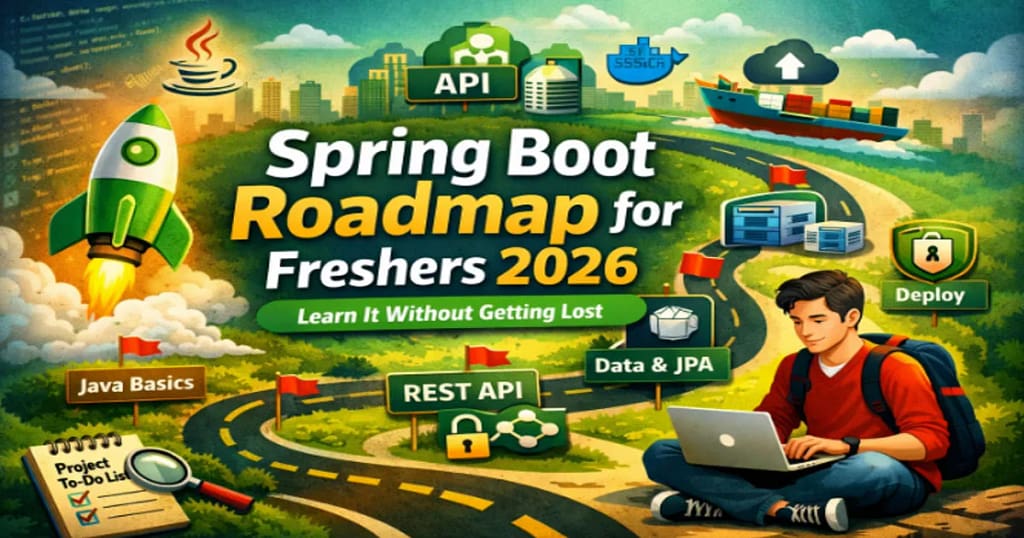
Starting backend development can feel confusing, especially when you search for a Spring Boot roadmap for freshers 2026 and find hundreds of tutorials pointing in different directions.
Many beginners jump between videos, courses, and documentation without knowing what to learn first. The result is frustration and slow progress. This guide simplifies the journey by providing a clear, step-by-step roadmap to learn Spring Boot from scratch, so freshers can focus on the right skills and avoid getting lost.
What Is Spring Boot & Why Freshers Should Care in 2026
Spring Boot is a Java-based framework that simplifies building backend applications and REST APIs.
It is built on top of the Spring Framework but removes much of the complex configuration that older Spring applications required.
In simple terms:
Spring Framework: Powerful but complex
Spring Boot: Faster and easier way to build Spring applications
Why companies use Spring Boot
Many modern platforms rely on Java backend systems for scalability and reliability.
Spring Boot is commonly used for:
REST APIs
Microservices
Banking systems
E-commerce platforms
Cloud-based applications
Companies in industries like fintech, SaaS, and enterprise software often rely on Spring Boot because it integrates well with modern tools such as Docker and cloud platforms.
The official Spring documentation also emphasizes Spring Boot’s goal of “making it easy to create stand-alone, production-grade Spring applications.”
Spring vs Spring Boot: What’s the Difference?
Many beginners get confused between Spring and Spring Boot.
Here’s the simple explanation.
| Feature | Spring Framework | Spring Boot |
|---|---|---|
| Configuration | Complex XML setup | Automatic configuration |
| Setup time | Slow | Fast |
| Dependencies | Manual management | Starter dependencies |
| Development speed | Slower | Faster |
Spring Boot removes the heavy configuration and allows developers to start building APIs quickly.
That’s why most modern Java backend projects use Spring Boot instead of traditional Spring.
What You Must Know Before Starting Spring Boot

Many freshers struggle with Spring Boot because they skip the basics.
Before learning Spring Boot, make sure you understand these topics.
1. Core Java Fundamentals
Spring Boot is still Java at its core.
You should be comfortable with:
Object-Oriented Programming (OOP)
Classes and objects
Interfaces
Exception handling
Collections (List, Map, Set)
Streams and lambdas (basic understanding)
Without strong Java fundamentals, Spring Boot will feel confusing.
Before learning Spring Boot, you must have a strong understanding of Java fundamentals like OOP, collections, and exception handling. If you’re still building your base, you should first follow a Java developer roadmap for freshers 2026 to understand the complete learning path.
2. Basic SQL & Databases
Most backend applications store data in databases.
Important concepts to understand:
SQL queries (SELECT, INSERT, UPDATE, DELETE)
Primary keys
Relationships (One-to-Many, Many-to-Many)
Basic database design
Common databases used with Spring Boot include:
MySQL
PostgreSQL
H2 (for testing)
3. HTTP and REST API Basics
Spring Boot is mostly used to build REST APIs.
You should understand:
HTTP methods (GET, POST, PUT, DELETE)
Request and response structure
Status codes (200, 404, 500)
JSON data format
These concepts make learning Spring Boot much easier.
The Honest Spring Boot Learning Roadmap (Phase by Phase)
Instead of jumping directly into complex projects, follow this structured learning path.
Phase 1: Spring Boot Fundamentals
Start by learning how a basic Spring Boot application works.
Key topics:
Spring Initializr project setup
Maven or Gradle dependencies
Auto-configuration
Annotations
Controllers
Application properties
At this stage, your goal is simple:
Run your first Spring Boot application and create a basic endpoint.
Example:
Response:
This small step helps you understand the framework structure.
Phase 2: Building REST APIs
Once you understand the basics, start building APIs.
Topics to focus on:
REST controller
Request mapping
Path variables
Request body
Response entities
Input validation
You will learn how to create CRUD APIs.
Example API endpoints:
POST /students
PUT /students/{id}
DELETE /students/{id}
At this stage, you are learning how backend services work.
Phase 3: Data Layer with Spring Data JPA
Real applications need database integration.
Spring Boot simplifies this using Spring Data JPA.
Important topics:
Entity classes
JPA repositories
Hibernate basics
Database configuration
H2 database for testing
MySQL or PostgreSQL for production
Spring Data JPA automatically generates database queries, which saves a lot of development time.
Phase 4: Security Basics
Security is a critical part of backend development.
Learn the basics of Spring Security.
Topics to cover:
Authentication
Authorization
Role-based access
JWT tokens
Password encryption
Many real-world APIs require JWT authentication, so this skill is highly valuable for freshers.
Phase 5: Deployment Awareness
Most beginners stop after building APIs.
But companies expect developers to understand how applications run in production.
Learn basic deployment concepts such as:
Docker basics
Environment configuration
CI/CD basics
Spring Boot Actuator
Logging and monitoring
You don’t need deep DevOps knowledge, but basic awareness helps in interviews.
Common Mistakes Freshers Make When Learning Spring Boot
Many beginners get stuck because they follow the wrong learning approach.
Here are common mistakes to avoid.
1. Tutorial Hell
Watching endless tutorials without building anything.
Instead:
Build small projects after every topic.
2. Skipping Java Fundamentals
Spring Boot becomes confusing if you don’t understand Java concepts like dependency injection or interfaces.
Strengthen Java basics first.
3. Learning Microservices Too Early
Microservices are an advanced architecture.
Freshers should first focus on:
Monolithic applications
REST APIs
Database integration
Only later move to microservices.
Best Resources to Learn Spring Boot in 2026
These resources are widely recommended by developers.
Official Documentation
Spring Boot official documentation is the most reliable learning resource.
Reference: https://spring.io/projects/spring-boot
YouTube Channels
Helpful free tutorials include:
These channels explain Spring Boot concepts clearly for beginners.
Structured Courses
Popular structured courses:
Udemy Spring Boot courses
Backend Java bootcamps
University programming courses
A structured course can accelerate learning if you prefer guided lessons.
Many developers today also use AI tools to speed up debugging, documentation, and code understanding. If you’re curious, here are some of the best AI tools for programmers in 2026 that can help beginners learn faster.
Spring Boot Project Ideas for Beginners
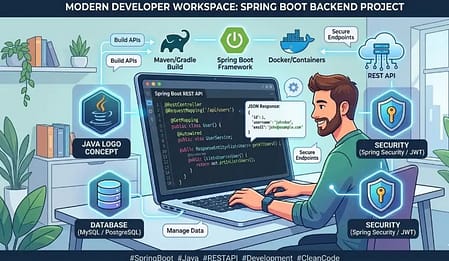
Projects are essential for building a developer portfolio.
Here are beginner-friendly project ideas.
1. Student Management System
Features:
CRUD operations
Database integration
REST API endpoints
This project teaches backend fundamentals.
2. Blog REST API
Features:
Create posts
Update posts
Delete posts
Pagination
This helps you learn API design and database relationships.
3. JWT-Secured Todo Application
Features:
User authentication
JWT login system
Secure API endpoints
This project demonstrates security and real-world API usage.
Is Spring Boot Worth Learning in 2026?
Yes, but only if you learn it the right way.
Spring Boot remains a major backend framework because:
Many enterprise systems use Java
Java remains widely used in banking and fintech
Spring Boot supports microservices and cloud deployment
However, companies expect more than just Spring Boot.
A fresher backend developer should know:
Java fundamentals
REST APIs
Databases
Git
Basic deployment concepts
Spring Boot becomes the core backend skill that connects everything.
Can a fresher get a job with Spring Boot skills?
Yes, but projects matter more than theory.
Companies look for evidence of capability, not just course certificates.
Your portfolio should include:
2–3 backend projects
GitHub repositories
API documentation
Clean code
Even small projects demonstrate real skills.
Many beginners wonder if Spring Boot alone is enough to get hired. In reality, companies look for practical projects and coding ability. If you’re preparing for your first backend role, this guide on how to get a Java developer job with no experience explains the strategies freshers use to get their first opportunity.
Best Way to Learn Spring Boot 2026
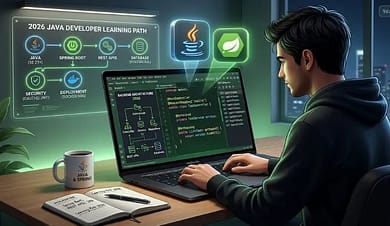
The best way to learn Spring Boot in 2026 is not by watching endless tutorials or jumping directly into microservices, but by following a structured, project-based learning approach. Freshers often waste months trying random courses without understanding the core fundamentals of Java, REST APIs, and database integration. A clear step-by-step roadmap — starting with Java basics, then Spring Boot fundamentals, followed by REST APIs, JPA, security, and real-world projects — helps you build practical backend skills faster and avoid confusion. Instead of trying to learn everything at once, focusing on small projects and consistent practice is the most effective way to master Spring Boot and become job-ready in 2026.
My Experience Learning Spring Boot as a Beginner
When I first started learning Spring Boot, the hardest part wasn’t the code — it was figuring out where to start. Every tutorial seemed to jump straight into complex setups, and within minutes people were talking about microservices, Docker, and cloud deployments. Meanwhile, I was still trying to understand why my controller wasn’t returning a simple JSON response.
One mistake I made early was watching too many tutorials without building anything. It felt productive, but when I tried creating my own project, I realized I didn’t actually understand the flow of a Spring Boot application. Things only started making sense when I built small projects — even something simple like a basic CRUD API.
Another lesson was respecting the Java fundamentals. Spring Boot hides a lot of complexity, but if you don’t understand concepts like interfaces, dependency injection, or exceptions, debugging becomes painful.
I also remember spending nearly an hour trying to fix a database connection issue that turned out to be one missing configuration line. Frustrating at the time, but that’s how the learning sticks.
What helped the most was treating Spring Boot as a tool to build things, not just something to study. Once you start creating APIs and connecting them to a database, the framework begins to feel much less intimidating.
FAQ (Frequently Asked Question)
1. What is Spring Boot and what is it used for?
Spring Boot is an open-source Java framework designed to simplify the development of Spring-based applications. It provides automatic configuration, embedded servers, and starter dependencies so developers can create stand-alone, production-ready applications with minimal setup. Developers commonly use Spring Boot to build web applications, REST APIs, microservices, and enterprise backend systems. The framework is built on top of the Spring ecosystem and aims to reduce complex configuration required in traditional Spring projects.
2. What prerequisites should a beginner learn before starting Spring Boot?
Before learning Spring Boot, beginners should understand core Java programming concepts such as object-oriented programming, exception handling, and collections. Knowledge of HTTP basics and REST APIs is also important because Spring Boot is commonly used to build web services. Basic database knowledge and SQL queries help when working with frameworks like Spring Data JPA that connect applications to relational databases. The official Spring documentation also indicates that modern Spring Boot versions require a compatible Java version, typically Java 17 or later.
Source: Spring Documentation
Source: Oracle
3. What is the difference between Spring Framework and Spring Boot?
The Spring Framework provides a large set of tools for building Java applications, including dependency injection, data access, and web frameworks. However, traditional Spring projects often require manual configuration and setup. Spring Boot builds on top of the Spring Framework and introduces features such as auto-configuration, embedded web servers, and predefined starter dependencies to simplify development. This approach allows developers to start applications quickly with fewer configuration steps.
Source: Spring Project Documentation
Source: Wikipedia
4. How long does it usually take to learn Spring Boot as a beginner?
The time required to learn Spring Boot varies depending on a learner’s existing Java knowledge and practice time. Beginners who already understand Java, SQL, and basic web concepts may learn the fundamentals of Spring Boot within several weeks through tutorials and projects. However, building production-ready applications typically requires additional experience with related technologies such as databases, security, and deployment tools. There is no official timeline published by the Spring project, and learning speed differs between individuals.
Source: Spring Boot Documentation
Source: GeeksforGeeks
5. Is Spring Boot still relevant to learn in 2026?
Spring Boot continues to be widely used for building modern Java applications because it simplifies the development of web services and microservices. The framework includes features such as embedded servers, automatic configuration, and production-ready tools like monitoring and health checks. It also integrates with technologies used in modern software systems, including databases, security modules, and cloud platforms. As of 2026, there is no official indication from the Spring project that development or support for Spring Boot is being discontinued.
Source: Spring
Source: GeeksforGeeks
External References and Resources
Key Points to remember
Spring Boot is one of the most widely used Java backend frameworks in modern software development.
Freshers must first learn Core Java, SQL, and REST basics before starting Spring Boot.
The best approach is learning through phases: fundamentals → APIs → database → security → deployment.
Building portfolio projects matters more than watching tutorials.
Spring Boot alone is not enough for jobs; companies expect knowledge of APIs, databases, and deployment basics.
Conclusion
Learning Spring Boot in 2026 doesn’t have to be overwhelming.
Most beginners struggle because they jump between random tutorials without a clear roadmap.
The smarter approach is simple:
Master Java basics
Learn Spring Boot fundamentals
Build REST APIs
Integrate databases
Add security and deployment awareness
If you follow this roadmap and build a few real projects, you’ll develop practical backend development skills that companies value.
Start with Phase 1 today, build your first API, and keep improving step by step.
Download the Spring Boot roadmap for freshers 2026 (PDF)
If you want a quick reference while learning, you can download the complete Spring Boot Roadmap for Freshers 2026 as a checklist.
This PDF includes:
Step-by-step learning roadmap
Spring Boot project ideas
Beginner checklist
Backend developer skills
Download the PDF Guide : SpringBoot_Freshers_2026_Guide
Share this:

Discover more from GroWithMoney
Subscribe to get the latest posts sent to your email.