Last Updated on April 25, 2026 by Rex
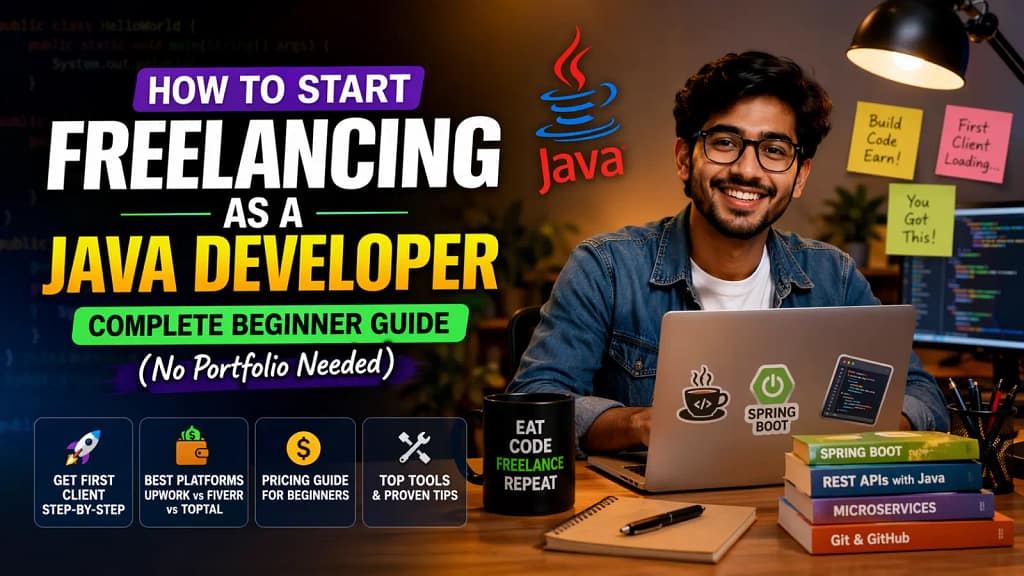
If you’re wondering how to start freelancing as a Java developer with no experience, this guide will walk you step-by-step.
Breaking into freelancing sounds exciting—until you actually try it.
You create a profile.
You send proposals.
And then… nothing happens.
Most beginner Java developers assume freelancing is only for experts with years of experience. But the truth is different.
Companies worldwide constantly hire freelance backend developers to build APIs, fix bugs, deploy microservices, and maintain legacy Java applications. The demand is real—even for beginners.
What most new developers lack isn’t skill.
It’s strategy.
This freelance java developer beginners guide will show you exactly how to start freelancing as a Java developer—even if you have zero portfolio, zero reviews, and zero freelance experience.
My Experience Starting as a Freelance Java Developer
When I started freelancing, I genuinely believed that building a few Spring Boot projects would be enough to get clients. It wasn’t.
In early 2023, I created my first profile on Upwork and started applying to jobs. My first 10–15 proposals got zero replies. I used to check my inbox every few hours expecting something to change—but nothing did.
The turning point came when I changed how I wrote proposals.
Instead of saying “I can do this,” I started focusing on the client’s problem. For one job, I specifically explained how I would debug their Spring Boot authentication issue instead of just claiming I had the skills.
That approach got me my first response.
My first paid project was a $30–$40 bug fix involving a Spring Boot API authentication issue. It wasn’t a big project, but it mattered. I delivered it quickly, communicated clearly, and received a 5-star review.
That single review changed everything.
Within the next 4–6 weeks, I landed 2 more small projects, all related to backend fixes and API improvements. Nothing huge—but enough to build momentum and confidence.
The biggest lesson I learned?
Small projects are not “small”—they’re entry points.
If you’re starting out, expect silence in the beginning. It’s part of the process. What matters is improving your proposals and staying consistent.
Once you get that first response, things start moving faster than you expect.
Why Java Developers Struggle to Get Freelance Clients
Many beginners make the same mistakes when entering the java developer gig economy.
Common Problems
• Generic profiles like “Java Developer Available”
• No clear niche (Spring Boot, APIs, backend, etc.)
• No portfolio examples
• Poor proposals
• Wrong pricing strategy
On competitive freelance platforms like Upwork, popular jobs can attract dozens of proposals, especially in entry-level categories. The exact number varies widely depending on budget, niche, and urgency.
The Fix: Position Yourself as a Problem Solver
Instead of saying: I am a Java developer.
Say: I build secure REST APIs using Spring Boot that scale to thousands of users.
Clients don’t hire programming languages.
They hire solutions.
What Freelance Java Developers Actually Do
Before entering freelancing, it helps to understand what services clients typically need.
Most Common Freelance Java Projects
- Building REST APIs using Spring Boot
- Backend development for mobile/web apps
- Fixing bugs in legacy Java systems
- Database integrations (MySQL, PostgreSQL)
- Microservices architecture
- Payment gateway integration
- Performance optimization
Many startups prefer freelancers because hiring full-time engineers is expensive.
Demand for freelance backend developers in India has been steadily increasing, driven by startups, SaaS companies, and global hiring trends that favor remote work.
Best Platforms to Start Java Freelancing
Choosing the right platform can dramatically increase your chances of landing clients.
Below is a comparison of the most popular freelance platforms.
| Platform | Best For | Difficulty Level | Fees | Ideal For |
|---|---|---|---|---|
| Upwork | Long-term freelance work | Medium | 10% | Beginners and professionals |
| Fiverr | Service-based gigs | Easy | 20% | Quick small projects |
| Freelancer | Competitive bidding | Medium | 10% | Global freelancing |
| Toptal | Elite developers | Hard | Low | Experienced developers |
1. Upwork
Best platform for beginners.
Advantages:
- Large client base
- Long-term contracts
- High-paying backend projects
Drawbacks:
- Requires strong proposals
- Competitive marketplace
Tip: Learn java freelancing Upwork tips before sending proposals.
2. Fiverr
Fiverr works differently.
Instead of applying to jobs, you create gigs such as:
- “I will build Spring Boot REST API”
- “I will fix Java backend bugs”
Good for beginners because clients find you.
3. Freelancer.com
Large global marketplace with thousands of projects.
However, competition is intense because many freelancers bid at very low prices.
4. Toptal
Toptal claims to accept only the top 3% of freelance talent through its screening process.
Beginners usually don’t qualify yet, but it’s a great long-term goal.
How to Build a High-Converting Freelance Profile
Your freelance profile acts as your sales page.
A weak profile = no clients.
Here’s how to build a strong one.
1. Profile Title (First Thing Clients See)
Avoid generic titles.
Bad example: Java Developer
Good examples:
- Java Backend Developer | Spring Boot & REST APIs
- Spring Boot Developer | Scalable Backend Solutions
- Java API Developer | Microservices & Cloud Deployment
Clear specialization increases client trust.
2. Profile Bio Structure
Use a simple 4-part structure.
Example Bio
Intro
Hi, I’m a Java backend developer specializing in building secure REST APIs using Spring Boot.
Experience
I have built backend systems for web applications including authentication systems, payment integrations, and microservices architecture.
What I Can Help With
- Spring Boot backend development
- REST API development
- Database integration
- Bug fixing and performance optimization
Call To Action
If you’re looking for a reliable backend developer, feel free to send a message.
3. Portfolio (Even Without Experience)
Beginners often worry: How do I show a portfolio without clients?
Use demo projects.
Simple Portfolio Ideas
Create 3 small backend projects:
- E-commerce API
- Product CRUD
- Cart API
- Authentication
- Task Management API
- User login
- Task CRUD
- JWT authentication
- Blog Backend System
- Posts
- Comments
- Admin panel API
You don’t need complex apps in the beginning. Even simple ideas from these Java projects for freshers are enough to get started.
Upload code on GitHub and include:
- Project description
- API endpoints
- Screenshots
- Deployment link
This instantly builds credibility.
Instead of waiting for real client work, start with demo projects. If you’re confused about what to build, these Java developer portfolio projects that get you hired can give you clear direction.
How to Get Your FIRST Java Freelance Client
Getting the first client is the hardest part.
Here’s the approach that worked for me and is commonly recommended by experienced freelancers on platforms like Upwork.
Step 1: Choose a Clear Java Niche
Don’t position yourself as just a “Java Developer.”
Pick one:
- Spring Boot API Developer
- Backend Developer for Startups
- Java Bug Fix Specialist
Clarity = more replies.
Step 2: Build 2–3 Demo Projects (Your Proof)
You don’t need real clients to start.
Create:
- E-commerce REST API
- Task Manager with JWT Auth
- Blog Backend System
Upload on GitHub with:
- Clean README
- API endpoints
- Screenshots
This replaces “experience.”
Step 3: Optimize Your Freelance Profile
Your profile decides whether clients click or skip.
Title Example:
Java Backend Developer | Spring Boot & REST APIs
Bio Formula:
- What you do
- What you’ve built
- How you help
- Call to action
Think of it as your landing page.
Step 4: Target Small, Low-Competition Jobs First
Don’t chase big projects early.
Search for:
- “Fix Spring Boot bug”
- “API not working”
- “Database issue Java”
These jobs:
- Have fewer proposals
- Convert faster
- Build your first reviews
Step 5: Send Problem-Focused Proposals
This is where most beginners fail.
Bad:
“I can do this job.”
Good:
“I noticed your Spring Boot API has an authentication issue. This is likely due to JWT filter misconfiguration—I’ve solved a similar issue recently and can fix this quickly.”
Clients respond to understanding, not desperation.
Step 6: Offer Quick Value Upfront
Give a small insight before getting hired.
Example:
“I suspect the issue might be in your security config or token validation logic.”
This:
- Builds trust instantly
- Makes you stand out from 50+ proposals
Step 7: Price Smartly for Your First 3–5 Projects
Your first goal is NOT money.
It’s:
- Reviews
- Ratings
- Social proof
Start slightly lower, then increase after 3–5 successful jobs.
That’s when real growth begins.
Final Insight
Freelancing is not about being the best developer.
It’s about:
- Positioning
- Communication
- Consistency
Master these 7 steps, and getting clients becomes a system—not luck.
Freelance Java Developer Pricing Guide
Pricing is confusing for beginners.
Let’s break it down.
Hourly vs Fixed Pricing
Hourly
Best for:
- Bug fixes
- Consulting
- Long-term work
Fixed Price
Best for:
- API development
- Small backend modules
- Short-term projects
Average Beginner Rates
| Region | Beginner Hourly Rate | Intermediate Rate |
|---|---|---|
| India | $10 – $20/hr | $25 – $50/hr |
| Global | $20 – $40/hr | $50 – $100/hr |
As a freelance backend developer India, you can start lower and gradually increase pricing as you gain reviews.
High-Paying Java Freelancing Niches in 2026
Not all Java skills are equal.
Some niches command much higher rates.
1. Spring Boot Microservices
Microservices architecture is widely used by startups and SaaS companies.
2. Cloud-Native Java Development
Skills like:
- AWS deployment
- Docker
- Kubernetes
increase freelance opportunities significantly.
3. Fintech Backend Systems
Banks and fintech startups use Java heavily.
These projects usually pay well due to security requirements.
4. Legacy Java System Maintenance
Many companies still run old Java systems.
Maintaining them is less glamorous—but very profitable.
Essential Tools for Freelance Java Developers

Freelancing isn’t just coding.
You also need tools to manage clients and projects.
Communication
- Slack
- Zoom
- Google Meet
Clear communication improves client satisfaction.
Contracts
Useful tools:
- Bonsai
- HelloSign
- DocuSign
Contracts protect both freelancer and client.
Payments
Popular options:
- PayPal
- Wise
- Payoneer
These platforms support international payments.
Time Tracking
Useful tools:
- Toggl
- Clockify
- Upwork tracker
Tracking time improves transparency with clients.
If you’re wondering how these rates compare in the real market, this detailed breakdown of Java developer salary in India gives a clearer picture.
Common Mistakes New Freelancers Make
Avoid these mistakes early.
- Applying to every job
- Writing generic proposals
- Underpricing for too long
- Ignoring communication
- Taking projects outside expertise
Freelancing success comes from reputation and reliability.
Actionable Checklist: Start Java Freelancing Today
Use this checklist to launch your freelancing career.
- Create profiles on Upwork and Fiverr
- Choose a niche (Spring Boot APIs recommended)
- Build 3 demo backend projects
- Upload projects on GitHub
- Write a strong profile title and bio
- Start applying to small jobs
- Send personalized proposals
- Deliver first projects quickly and professionally
Once you complete these steps, landing your first freelance client becomes much easier.
Frequently Asked Questions (FAQ)
1. Can beginners really start freelancing as a Java developer with no experience?
Yes, beginners can start freelancing without prior client experience, but they need to demonstrate practical skills through personal or demo projects. Freelance platforms like Upwork recommend showcasing relevant work samples, even if they are self-created, to build credibility. According to industry guidance, clients primarily evaluate skills, communication, and problem-solving ability rather than formal job history. However, competition can be high, so consistent effort in applying and improving profiles is necessary.
Source: Upwork Help Center
2. Which platform is best for beginner Java freelancers?
There is no single “best” platform, as it depends on the freelancer’s goals and experience level. Platforms like Upwork and Fiverr are widely used by beginners because they offer a large number of entry-level projects and flexible work options. Toptal, on the other hand, has a strict screening process and is generally not suitable for beginners. Each platform has different fee structures and competition levels, so beginners often try multiple platforms to see what works best.
Source: Fiverr Help Center
3. How much do freelance Java developers typically earn?
Freelance earnings vary based on experience, location, and specialization. According to Glassdoor and PayScale, Java developers’ hourly rates can range widely, with freelancers often charging between $20 and $100+ per hour depending on expertise. Beginners usually start at lower rates to build reviews and gradually increase pricing. There is no fixed global standard, and actual income depends on project availability and client demand.
Source: Glassdoor
4. Do freelance Java developers need to know frameworks like Spring Boot?
Yes, knowledge of frameworks like Spring Boot is highly recommended because it is widely used in modern Java backend development. According to the official Spring documentation, Spring Boot simplifies the process of building production-ready applications and REST APIs. Many freelance projects specifically require experience with Spring Boot for backend services. While basic Java knowledge is important, frameworks significantly improve job opportunities.
Source: Spring Official Documentation
5. How long does it take to get the first freelance client?
The time required to get the first client varies depending on effort, profile quality, and market demand. Some freelancers may secure a project within a few weeks, while others may take longer due to competition and limited experience. Upwork suggests that new freelancers should apply consistently and improve their proposals to increase success chances. There is no guaranteed timeline, and results differ for each individual.
Source: Upwork Blog
6. Where to find Java freelance jobs
Java freelance jobs are commonly available on platforms like Upwork, Fiverr, and Freelancer. These platforms allow developers to apply for backend, API, and maintenance projects. Beginners should search for small tasks initially to reduce competition and gain reviews before targeting higher-paying projects.
7. Freelance Java developer salary
Freelance Java developer income varies based on experience, skills, and location. Beginners may start with lower hourly rates, while experienced developers charge significantly more for specialized work like microservices or cloud-based systems. Income is not fixed and depends on project availability and client demand.
Final Thoughts: Freelancing Is a Skill, Not Just a Career
Starting freelancing as a Java developer can feel intimidating.
But remember:
Most successful freelancers didn’t start with perfect portfolios or huge experience.
They started with small projects, consistent proposals, and a willingness to learn.
The opportunity is huge.
Companies around the world are actively hiring freelance developers to build and maintain backend systems.
If you follow the strategies in this freelance java developer beginners guide, your first client may be closer than you think.
Start today.
Create your profile.
Build one demo project.
Send your first proposal.
Your freelancing journey begins with that first step.
If you’re still figuring out what to learn first, this Java roadmap for freshers will help you build the right foundation.
Share this:

Discover more from GroWithMoney
Subscribe to get the latest posts sent to your email.