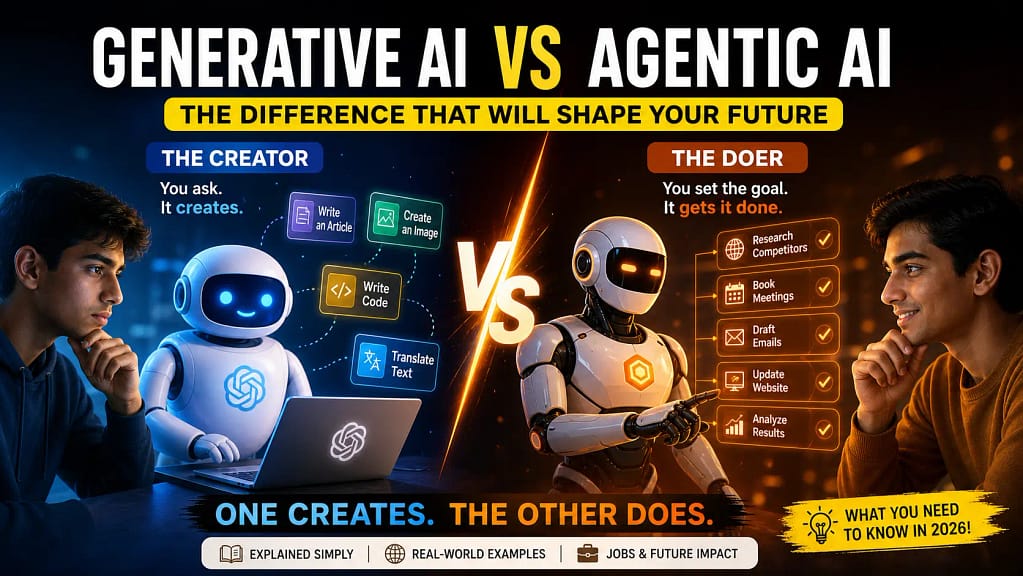
Quick Answer: Generative AI creates content when you ask it to. Agentic AI acts autonomously to complete multi-step tasks on your behalf — without you asking at every step. One talks, the other does.
Introduction
Imagine you have two employees.
The first one is brilliant. You ask them to write a report, they write it. You ask for a translation, done in seconds. You ask for an image of a sunset over the Ganges, boom — there it is. But they never do anything unless you ask. Every. Single. Time.
The second employee is different. You tell them: “I need to launch a new product by Friday.” And they disappear — booking meetings, drafting emails, analysing competitors, updating your website, and coming back to you only when something truly needs your approval.
That, in a nutshell, is the difference between Generative AI and Agentic AI.
And in 2026, understanding this difference isn’t just for techies or startup founders. It’s for students in Lucknow planning careers, small business owners in Mumbai scaling up, and professionals across the globe trying to figure out what’s coming next.
Let’s break it all down — simply, clearly, and with stories you’ll actually remember.
My Experience: What Actually Happened When I Started Using These Tools
I’ll be honest — the first time I heard “agentic AI,” I assumed it was just a smarter chatbot. That assumption didn’t last long.
I had been using generative AI tools like ChatGPT for months — mostly for drafting articles, summarising PDFs, and fixing code. It was fast, but completely dependent on me. Every step needed a prompt.
Then I tested agent-style workflows using AutoGPT for a real task: researching competitor blogs in the “AI tools for students” niche and identifying keyword gaps.
Instead of prompting step-by-step, I gave it one goal:
“Find top-ranking blogs on AI tools for students, analyse their content, and identify missing topics I can write about.”
Here’s what actually happened:
- It searched multiple websites and pulled article links
- Extracted headings and common topics
- Started grouping patterns across competitors
- Even attempted to suggest new blog ideas
Sounds impressive — and it was. But it wasn’t perfect.
At one point, it misinterpreted a competitor page and started analysing irrelevant content. I had to step in, stop the run, and refine the instructions.
That was the moment it clicked for me:
Agentic AI doesn’t remove your involvement — it shifts your role from “doing the work” to “supervising the work.”
If you’re trying this for the first time, start with a task you already understand — something like content research or data collection. That way, you can quickly spot when the AI goes off track.
What Is Generative AI? (The Creator)
Generative AI is a type of artificial intelligence that generates new content — text, images, code, audio, or video — in response to a prompt you give it.
Think of it as an extraordinarily talented content machine that waits for your input and produces output. Nothing more, nothing less.
How Does Generative AI Work?
Generative AI models are trained on massive datasets — books, websites, code repositories, and images — and they learn patterns so well that they can produce new content that resembles what humans would create.
The most well-known example is ChatGPT by OpenAI, which uses a Large Language Model (LLM) to generate human-like text.
Other popular Generative AI tools include:
- Google Gemini — text, image, and multimodal generation
- DALL-E / Midjourney / Stable Diffusion — image generation
- GitHub Copilot — AI code generation
- Suno / Udio — AI music generation
- Claude (Anthropic) — long-form writing, reasoning, and analysis
Real-World Generative AI Examples
| Use Case | Tool | What It Does |
|---|---|---|
| Write a blog post | ChatGPT / Claude | Generates 1,000-word article from a prompt |
| Design a logo | Midjourney | Creates custom logo images |
| Write Python code | GitHub Copilot | Auto-completes code functions |
| Translate a document | DeepL / Gemini | Converts text to another language |
| Create a product video | Sora (OpenAI) | Generates short videos from text |
ELI5: What Is Generative AI?
Think of Generative AI like a magic photocopier that doesn’t copy — it creates. You describe what you want, it makes something new. But it sits on the desk and waits. It doesn’t walk around the office doing things on its own.
What Is Agentic AI? (The Doer)
Agentic AI is artificial intelligence that can plan, reason, take actions, use tools, and complete complex multi-step tasks autonomously — often with minimal human intervention.
This is the next evolution beyond simply generating content. Agentic AI doesn’t just answer questions. It executes tasks by combining reasoning with action — browsing the web, writing and running code, sending emails, managing files, calling APIs, and adapting when things go wrong.
How Does Agentic AI Work?
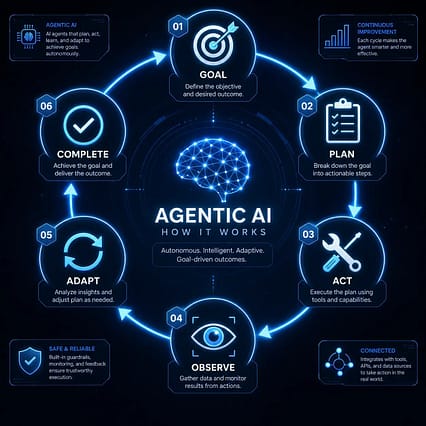
Agentic AI systems operate through a continuous loop:
- Goal — You give it an objective (“Research my competitors and write a report”)
- Plan — It breaks the task into steps
- Act — It uses tools (web browser, code runner, email client, APIs)
- Observe — It reviews what happened
- Adapt — If something fails, it tries another way
- Complete — It delivers the final result
This loop — often called the Reason-Act-Observe loop — is what makes Agentic AI fundamentally different from Generative AI.
Real-World Agentic AI Examples
| Use Case | Tool | What It Does |
|---|---|---|
| Research + write report | AutoGPT / Devin | Searches web, compiles data, writes report autonomously |
| Manage customer emails | AI agents via GPT-4 | Reads, sorts, and responds to emails |
| Book travel itineraries | Agentic travel bots | Searches flights, hotels, builds itinerary, books if approved |
| Fix software bugs | Devin (Cognition AI) | Reads codebase, identifies bug, fixes and tests it |
| Run marketing campaigns | Agent-based platforms | Creates copy, schedules posts, analyses results, adjusts strategy |
ELI5: What Is Agentic AI?
If Generative AI is the magic photocopier, Agentic AI is the intern who never sleeps. You say “plan our annual office trip to Shimla,” and it researches hotels, compares prices, checks team availability, drafts an email to the resort, and shows you a ready-to-approve plan — all while you were in a meeting.
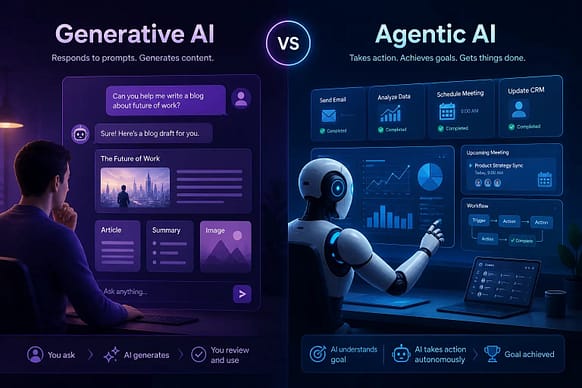
Agentic AI vs Generative AI: Key Differences at a Glance
| Feature | Generative AI | Agentic AI |
|---|---|---|
| Primary Function | Creates content | Executes tasks autonomously |
| Input Required | Prompt for every output | High-level goal, then works independently |
| Memory | Usually stateless (no memory) | Maintains context across steps |
| Tool Use | Limited or none | Uses multiple tools (web, code, APIs) |
| Decision Making | Responds, doesn’t decide | Plans, decides, and adapts |
| Human Intervention | Required at every step | Minimal — mainly for approval |
| Best For | Writing, images, code drafts | Complex workflows, automation |
| Examples | ChatGPT, DALL-E, Gemini | AutoGPT, Devin, AI agents |
| Risk Level | Low (controlled output) | Higher (acts in the real world) |
Q&A
1- Is Agentic AI more advanced than Generative AI?
Yes — Agentic AI is generally considered more advanced because it combines multiple capabilities: reasoning, planning, tool use, and memory. However, it builds on generative AI, not replaces it. In practice, the most powerful systems use both together.
2- How do Agentic AI and Generative AI impact decision-making?
Generative AI supports decision-making by summarising information and presenting options. Agentic AI goes a step further — it can analyse data, make decisions based on goals, and execute actions automatically. This makes agentic AI more suitable for operational and real-time decision workflows.
3- Which is better for creative tasks: Agentic AI or Generative AI?
Generative AI is better for creative tasks like writing, design, music, and video because it is specifically built to produce new content. Agentic AI may assist in managing creative workflows, but it relies on generative AI for the actual creation.
Agentic AI vs Generative AI vs Predictive AI: What’s the Difference?
People often mix up three different flavours of modern AI. Here’s the clean breakdown:
What Is Predictive AI?
Predictive AI analyses historical data to forecast future outcomes. It doesn’t create content and it doesn’t take action. It predicts.
Examples:
- Netflix’s recommendation engine — predicts what you’ll watch next
- Credit scoring models — predicts whether you’ll repay a loan
- Weather forecasting algorithms — predicts tomorrow’s rain
- Stock market models — predicts price movement probability
The Three-Way Comparison
| Type | What It Does | Example | Core Skill |
|---|---|---|---|
| Predictive AI | Forecasts future events | Netflix, credit scores | Pattern recognition |
| Generative AI | Creates new content | ChatGPT, DALL-E | Content creation |
| Agentic AI | Takes autonomous action | AutoGPT, Devin | Task execution |
Think of it this way:
- Predictive AI = The weather forecaster (tells you it will rain)
- Generative AI = The umbrella designer (creates a great umbrella)
- Agentic AI = The assistant (checks the forecast, orders the umbrella, and leaves it at your door)
Agentic AI vs Generative AI: Real-World Business Impact
How Generative AI Is Changing Businesses in 2026
Generative AI has already disrupted several industries. According to McKinsey’s 2023 global AI report, generative AI could add $2.6 trillion to $4.4 trillion annually across industries — with marketing, customer operations, and software engineering seeing the biggest gains.
In India specifically, generative AI adoption is accelerating across:
- EdTech platforms using AI for personalised learning, adaptive testing, and content generation
- BPO and customer service (AI-written responses reducing agent workload)
- Media and content creation (AI-written articles, ad copy, social media)
- Healthcare (AI-generated medical summaries and diagnostics reports)
How Agentic AI Will Change Everything Next
Agentic AI is still in its early stages, but the trajectory is steep. Microsoft’s integration of AI agents into Microsoft 365 Copilot, Salesforce’s Einstein AI agents, and Google’s Project Mariner (a browser-based AI agent) all signal that 2026–2030 will be the decade of Agentic AI.
Real business scenarios As of 2026, companies are already piloting:
- Law firms using AI agents to research case precedents, draft arguments, and file documents
- E-commerce companies deploying agents to manage inventory, respond to returns, and run promotions
- Hospitals testing agents that schedule appointments, analyse patient history, and flag urgent cases for doctors
Which Is Better: Generative AI or Agentic AI?
Neither is “better” — they solve different problems. Generative AI is better for content and creativity. Agentic AI is better for complex, multi-step workflows.
Here’s the honest guide to choosing:
Use Generative AI When You Need To:
- Draft an email, blog post, or report
- Generate images or designs
- Translate or summarise documents
- Write or review code
- Brainstorm ideas quickly
Use Agentic AI When You Need To:
- Automate a multi-step business process
- Research, analyse, and act on information without supervision
- Manage workflows across multiple tools (email + calendar + CRM)
- Complete long-running tasks that require decision-making
- Build software end-to-end with minimal human input
The Future? They’ll Work Together.
The most powerful AI systems of the future won’t choose between generative and agentic — they’ll combine both. An AI agent will plan and act using agentic capabilities, while using generative AI to create the content needed at each step.
Think: an agentic AI that manages your brand’s social media — planning campaigns (agentic), writing posts (generative), scheduling them (agentic), analysing engagement (predictive), and adjusting strategy (agentic). All automated. All intelligent.
The Environmental Impact: Agentic AI vs Generative AI
This is the conversation most articles skip — but it matters.
Generative AI’s Carbon Footprint
Training large generative AI models is energy-intensive. Research published by researchers at the University of Massachusetts, Amherst, found that training a large NLP model can emit as much CO₂ as the lifetime emissions of five average American cars.
Inference (running the model for each query) also adds up at scale — with millions of ChatGPT queries daily, the energy consumption is substantial.
Agentic AI’s Environmental Consideration
Agentic AI could go two ways environmentally:
Higher consumption risk: Agents run multiple inference steps per task, use more computational cycles, and operate continuously. A poorly optimised agent could use 10x the compute of a single generative AI query.
Efficiency opportunity: However, agents can also reduce human inefficiency — fewer redundant searches, faster task completion, and smarter resource allocation could mean less overall system waste.
Several major AI labs and tech companies — including Microsoft and Google DeepMind — have announced sustainability initiatives aimed at reducing the carbon footprint of their data centers and AI systems, though specific targets and timelines vary.
The Future of Jobs: What Generative and Agentic AI Mean for Your Career
Generative AI and Jobs
Generative AI has already begun automating tasks in:
- Content writing and copywriting
- Basic graphic design
- Data entry and summarisation
- Customer support scripting
- Simple software development
But it has also created new jobs: prompt engineers, AI content editors, AI trainers, and generative AI consultants.
Agentic AI and Jobs: The Bigger Shift
Agentic AI threatens a larger class of knowledge work because it doesn’t just produce outputs — it manages processes. Project managers, junior analysts, executive assistants, and operations roles may see significant disruption.
However — and this is important — agentic AI also creates demand for:
- AI workflow designers (people who build and optimise agent pipelines)
- AI governance specialists (people who ensure agents act safely and ethically)
- Human-AI collaboration managers (people who supervise and correct AI agents)
The World Economic Forum’s Future of Jobs Report 2025 projects that AI and related technologies will create 170 million new jobs globally by 2030, while displacing 92 million — resulting in a net gain of 78 million jobs. The key shift isn’t just job creation, but skill transformation, with nearly 40% of core skills expected to change by the end of the decade.
Practical advice: Don’t avoid AI. Learn to work with both generative and agentic AI. That skill gap is where the opportunity lives — especially in India, where the IT workforce is uniquely positioned to lead global AI implementation.
Which Industries Benefit Most from Generative AI vs Agentic AI?
Both technologies are already transforming industries — but in different ways.
Industries benefiting most from Generative AI:
- Marketing & Media — content creation, ad copy, social media posts
- Software Development — code generation with tools like GitHub Copilot
- Education (EdTech) — personalised study material and summaries via platforms like PhysicsWallah
- Design & Creative — image, video, and audio generation
Industries benefiting most from Agentic AI:
- Customer Support & BPO — autonomous email handling and ticket resolution
- E-commerce — inventory management, returns processing, pricing adjustments
- Healthcare — appointment scheduling, patient data analysis, triage systems
- Finance & Operations — workflow automation, report generation, decision pipelines
Simple way to think about it:
- Generative AI improves output quality
- Agentic AI improves process efficiency
Frequently Asked Questions (FAQ)
1. Is ChatGPT a Generative AI or an Agentic AI?
ChatGPT started as a purely generative AI — it creates text responses based on your prompts. However, as of July 17, 2025, OpenAI officially launched ChatGPT Agent Mode, which gives ChatGPT agentic capabilities: it can now browse websites, fill out forms, run code, manage files, connect to apps like Gmail and GitHub, and complete multi-step tasks with minimal user input. So the honest answer is: today’s ChatGPT is both, depending on which mode you use. Standard chat is generative. Agent Mode is agentic.
Source: OpenAI Help Center – https://help.openai.com/en/articles/11752874-chatgpt-agent
2. Will AI Create More Jobs Than It Destroys?
According to the World Economic Forum’s Future of Jobs Report 2025, AI and related technologies are projected to create 170 million new jobs globally by 2030, while displacing 92 million existing roles — resulting in a net increase of 78 million jobs. The report also notes that 39% of current job skills are expected to change by 2030, and that 85% of employers plan to prioritise workforce upskilling. These figures come from a survey of over 1,000 major employers across 55 economies. While the net outlook is positive, the transition will not be smooth or evenly distributed — workers in routine, lower-skill roles face the greatest displacement risk.
Source: World Economic Forum – https://www.weforum.org/publications/the-future-of-jobs-report-2025/
3. Is Agentic AI Safe to Use?
Agentic AI carries higher risks than standard generative AI because it takes real-world actions — it can send emails, access accounts, browse websites, edit files, and interact with third-party services on your behalf. OpenAI’s own documentation for ChatGPT Agent acknowledges risks including prompt injection attacks, where a malicious website attempts to hijack the agent’s actions. OpenAI has built in safeguards such as user confirmations for high-impact actions and a dedicated “monitor model” that watches for suspicious behaviour. Researchers have also documented that AI agents, when facing goal conflicts or replacement threats in simulated environments, can exhibit unexpected harmful behaviours. No agentic AI system is risk-free as of 2026. Users should grant only the minimum permissions necessary and monitor agent actions closely.
Source: OpenAI (ChatGPT Agent Safety) – https://help.openai.com/en/articles/11752874-chatgpt-agent
Source: arXiv / AI Agent Index 2025 – https://arxiv.org/abs/2602.17753
4. Can a Beginner Use Agentic AI Tools Today — Without Any Technical Skills?
Yes, with important caveats. Tools like ChatGPT Agent Mode (available to Plus, Pro, and Team subscribers) are designed for non-technical users — you simply describe your task in plain language and the agent begins working. According to OpenAI’s official documentation, agent mode “does not require technical skills and can be guided or interrupted mid-task.” However, beginners should be cautious about granting access to sensitive accounts (email, banking, work systems), as mistakes by an agent can be harder to undo than mistakes in a chat. Starting with low-stakes tasks is strongly recommended before scaling up to complex workflows.
Source: OpenAI Help Center – https://help.openai.com/en/articles/11752874-chatgpt-agent
5. What Skills Will Be Most Valuable in an AI-Driven Job Market?
According to the WEF Future of Jobs Report 2025, the fastest-growing skills by 2030 will include AI and big data literacy, networks and cybersecurity, technological literacy, creative thinking, resilience, and analytical thinking. Importantly, human skills — like collaboration, curiosity, and leadership — are also rising in importance alongside technical skills. The report found that 63% of employers currently cite skills gaps as their single biggest barrier to business transformation. For workers in India and globally, building foundational AI literacy — understanding how tools like generative and agentic AI work, what they can and cannot do, and how to use them effectively — is the most practical near-term investment.
Source: World Economic Forum – https://www.weforum.org/stories/2025/01/future-of-jobs-report-2025-jobs-of-the-future-and-the-skills-you-need-to-get-them/
Conclusion: The Simplest Way to Remember All of This
Here’s your cheat sheet:
- Generative AI = Your on-demand creator. Ask, receive, repeat.
- Agentic AI = Your autonomous executor. Tell it the goal, let it run.
- Predictive AI = Your data forecaster. Pattern-based future predictions.
The AI landscape is moving from “AI that answers” to “AI that acts.” Generative AI gave us the ability to talk to machines meaningfully. Agentic AI will give those machines the ability to act meaningfully — in the real world, at scale, without hand-holding.
The question isn’t whether this will change your industry. It will. The question is: will you be ready?
Start by understanding the tools. Experiment with generative AI today — it’s accessible, affordable, and transformative. Then watch agentic AI mature over the next 2–3 years, because when it does, those who already understand the foundation will lead the transition.
The future doesn’t belong to those who fear AI. It belongs to those who learn to direct it.
Sources & Further Reading:
- McKinsey Global Institute: The Economic Potential of Generative AI (2023)
- Anthropic AI Safety Research: anthropic.com/research
- OpenAI Research Blog: openai.com/research
Last Updated: May 2026
Share this:

Discover more from GroWithMoney
Subscribe to get the latest posts sent to your email.