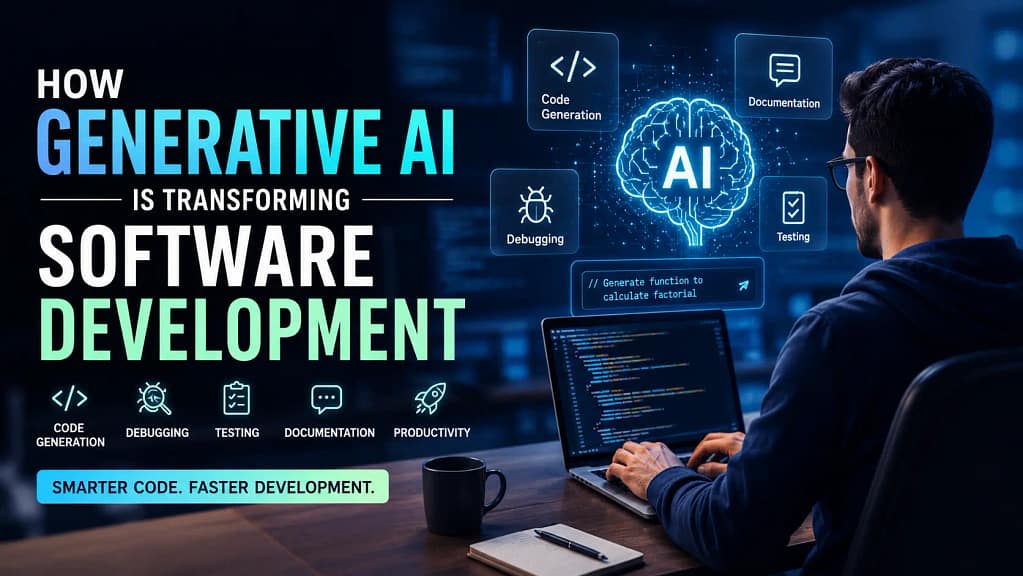
A few years ago, developers spent hours debugging simple syntax errors, writing repetitive boilerplate code, and searching Stack Overflow for tiny fixes.
In 2026, many developers describe software development differently.
They brainstorm ideas with AI.
They generate APIs in minutes.
They use AI to explain legacy code written 10 years ago.
Some even ship MVPs over a weekend with help from AI coding agents.
Generative AI is no longer just a futuristic concept. It is now deeply integrated into modern software development workflows.
From startups to enterprise companies, AI-powered coding tools are changing how software gets designed, tested, documented, and maintained.
But how exactly is generative AI used in software development? And what does it actually mean for developers, students, and businesses in 2026?
Let’s break it down clearly.
TL;DR
- Generative AI helps developers write, debug, optimize, test, and document code faster.
- Popular tools include OpenAI ChatGPT, GitHub Copilot, Google Gemini, Anthropic Claude, and AI coding agents.
- AI improves developer productivity but still requires human review.
- Companies use AI for automation, DevOps, cybersecurity, testing, and app modernization.
- Developers who learn AI-assisted coding are likely to gain a major career advantage in the coming years.
What I Experience
What Is Generative AI in Software Development?
Generative AI in software development refers to AI systems that can create or modify software-related content such as code, documentation, tests, architecture suggestions, and debugging solutions.
These systems are usually powered by large language models (LLMs) trained on massive datasets containing programming languages, technical documentation, and public repositories.
Popular examples include:
- OpenAI ChatGPT
- GitHub Copilot
- Google Gemini
- Anthropic Claude
- Microsoft Copilot for Developers
- Amazon Q Developer
Unlike traditional automation tools, generative AI understands natural language prompts.
For example, a developer can type:
“Create a REST API in Node.js with JWT authentication.”
The AI can generate working starter code almost instantly.
That shift is why AI in software development has become one of the biggest technology trends of 2025 and 2026.
How Generative AI Is Used in Software Development

AI Helps Developers Write Code Faster
The most common use of generative AI is code generation.
AI coding assistants can:
- Autocomplete code
- Generate functions
- Create APIs
- Build UI components
- Suggest algorithms
- Translate code between languages
Developers now frequently use AI like a “pair programmer.”
For example:
- Frontend developers generate React components faster.
- Backend engineers scaffold APIs automatically.
- Mobile developers create boilerplate code quickly.
- Students use AI to understand coding concepts.
Many developers report that AI coding assistants help reduce time spent on repetitive coding and debugging tasks.
AI Assists in Debugging and Error Fixing
Debugging can consume huge amounts of development time.
Generative AI helps by:
- Explaining error messages
- Identifying bugs
- Suggesting fixes
- Detecting logical issues
- Improving stack trace analysis
Instead of manually searching forums, developers can paste errors directly into AI tools and receive contextual explanations.
This is especially useful for beginners learning programming.
For example, AI can explain the following:
- Why a React hook causes infinite re-renders
- Why a SQL query fails
- Why memory leaks occur
- Why asynchronous functions break
The ability to simplify technical explanations is one reason AI developer tools became mainstream.
Can AI Generate Entire Applications?
Yes, but with limitations.
Modern AI tools can generate surprisingly complete applications, including the following:
- Authentication systems
- CRUD apps
- Dashboards
- Chatbots
- Landing pages
- Portfolio websites
- Internal business tools
Some AI coding agents can even:
- Read repositories
- Modify multiple files
- Run tests
- Suggest pull requests
However, fully autonomous software development is still unreliable for complex production systems.
Human oversight remains critical.
Experienced engineers still handle:
- Architecture decisions
- Security reviews
- Scalability planning
- Compliance
- Business logic validation
AI works best as an accelerator, not a replacement.
How AI Is Used in Software Testing
Software testing is another major area transformed by generative AI.
AI can automatically generate:
- Unit tests
- Integration tests
- Edge-case scenarios
- Mock data
- Test documentation
This saves developers significant time.
For example, developers can ask AI the following:
“Write Jest unit tests for this React component.”
The AI can instantly generate starter tests.
Some companies also use AI for:
- Automated QA workflows
- Regression testing
- Visual bug detection
- Performance testing analysis
Testing automation has become especially important as release cycles get faster.
AI in DevOps and Infrastructure Automation
Generative AI is increasingly used in DevOps workflows.
AI helps engineers:
- Write Dockerfiles
- Configure Kubernetes
- Create CI/CD pipelines
- Generate Terraform scripts
- Monitor infrastructure logs
Cloud engineering teams use AI to simplify repetitive operational tasks.
For example:
- AI can explain Kubernetes deployment errors.
- AI can optimize infrastructure configurations.
- AI can summarize incident reports.
This reduces operational overhead for engineering teams.
How Generative AI Helps Legacy Software Modernization
Many enterprises still run old software systems built years ago.
Some legacy codebases contain millions of lines of outdated code.
Generative AI helps companies modernize these systems faster.
AI can:
- Explain old code
- Generate documentation
- Translate legacy languages
- Suggest modernization paths
- Refactor outdated architecture
For example, enterprises may use AI to migrate:
- Java applications to cloud-native systems
- Old PHP codebases to modern frameworks
- Monolithic systems into microservices
This is becoming a huge business use case globally.
Benefits of AI in Software Development
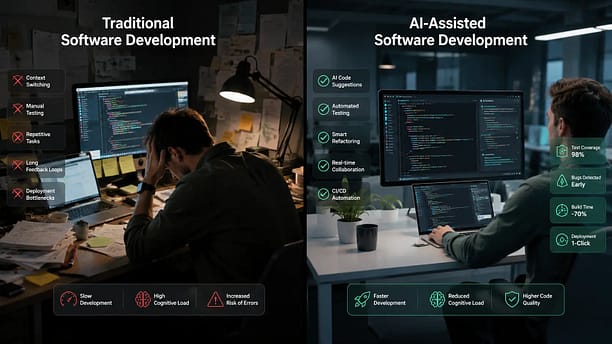
AI Improves Developer Productivity
The biggest benefit is speed.
AI reduces repetitive work and allows developers to focus on higher-level problem-solving.
Common productivity gains include:
- Faster prototyping
- Reduced debugging time
- Quicker documentation
- Faster onboarding
- Improved code understanding
Many startups now build MVPs much faster than before.
AI Helps Beginners Learn Faster
Generative AI acts like an interactive tutor.
Students can ask:
- “Explain recursion simply.”
- “Why does this Python code fail?”
- “Teach me REST APIs.”
Unlike static tutorials, AI provides contextual explanations.
That makes learning programming more interactive and accessible.
This is why searches for “Introduction to Generative AI for software development” and “Generative AI for software development course” have grown rapidly.
AI Reduces Boilerplate Coding
Developers dislike repetitive coding tasks.
AI automates much of this work.
Examples include:
- Authentication templates
- Form validation
- Database models
- API routes
- CRUD operations
This allows teams to move faster.
Challenges and Risks of AI in Software Development
AI Can Produce Incorrect Code
AI-generated code is not always accurate.
Models sometimes hallucinate APIs, create insecure code, or suggest outdated libraries.
Developers must always review outputs carefully.
Blindly copying AI-generated code is risky.
Security Risks Still Matter
AI tools may accidentally generate:
- Vulnerable authentication flows
- Unsafe SQL queries
- Exposed credentials
- Weak encryption logic
Security reviews remain essential.
Organizations increasingly combine AI tools with human security audits.
Copyright and Licensing Concerns Exist
Some companies worry about training data and code licensing issues.
Questions continue around the following:
- Open-source licensing
- Ownership of AI-generated code
- Intellectual property risks
This area is still evolving legally in many countries.
Real-World Examples of Generative AI in Software Development
Microsoft and AI Coding Assistants
Microsoft heavily integrated AI into developer workflows through GitHub Copilot and enterprise AI tooling.
Many developers now use AI-assisted coding daily inside IDEs like VS Code.
Google and Gemini for Developers
Google expanded Gemini into coding, debugging, and cloud workflows.
Developers use Gemini across Android development, cloud engineering, and documentation tasks.
OpenAI and ChatGPT for Development
ChatGPT became one of the most widely used AI developer assistants globally.
Developers use it for:
- Code explanations
- Architecture brainstorming
- Debugging
- Documentation
- Learning frameworks
Startups Building AI-Native Development Tools
Many startups now focus entirely on AI-powered development.
Examples include:
- AI code review tools
- Autonomous testing platforms
- AI DevOps assistants
- AI UI generation tools
This ecosystem continues growing rapidly in 2026.
How to Use AI in Software Development Effectively
Treat AI like a junior pair programmer.
AI works best when developers guide it carefully.
Provide:
- Clear prompts
- Context
- Constraints
- Desired outputs
The better the prompt, the better the result.
Always Verify AI Outputs
Never assume AI-generated code is production-ready.
Review:
- Logic
- Security
- Performance
- Scalability
- Dependencies
Human validation is critical.
Use AI for Repetitive Tasks First
The best early use cases include:
- Boilerplate code
- Documentation
- Refactoring
- Testing
- Debugging
This creates immediate productivity gains.
Will AI Replace Software Developers?
No, but it will change software engineering dramatically.
AI automates repetitive coding tasks, but companies still need human developers for the following:
- Product thinking
- System design
- Creativity
- Security
- Collaboration
- Business understanding
The role of developers is evolving rather than disappearing.
Developers who learn AI-assisted workflows will likely outperform those who ignore them.
Future Trends of AI in Software Development
AI Agents Will Become More Autonomous
AI coding agents are rapidly improving.
Future systems may:
- Handle larger projects
- Coordinate across repositories
- Automate testing pipelines
- Deploy applications autonomously
Still, human supervision will remain important.
AI-Native Software Engineering Will Grow
New developers increasingly build products with AI integrated from day one.
This includes:
- AI copilots
- AI automation
- AI customer support
- AI analytics
- AI-generated interfaces
AI-first development is becoming normal.
Demand for AI-Literate Developers Will Increase
Companies increasingly expect developers to understand:
- Prompt engineering
- AI-assisted workflows
- LLM limitations
- AI security practices
Learning AI tools is becoming a valuable career skill.
Best Resources to Learn Generative AI for Software Development
Popular learning resources include:
- Deep Learning. AI AI development courses
- OpenAI Documentation
- Google AI Documentation
- GitHub Docs
Books and online tutorials about “Generative AI for Software Developers” are also becoming increasingly popular among beginners and professionals.
Frequently asked Question (FAQ)
1. How is generative AI used in software development?
Generative AI is used to help developers write, debug, test, and document code more efficiently. AI coding assistants can generate code suggestions, explain programming errors, create unit tests, and help automate repetitive development tasks. Many modern tools also support natural language prompts, allowing developers to describe what they want in plain English. However, human review is still important because AI-generated code can contain mistakes or security issues.
Source: GitHub Copilot Docs
Source: OpenAI Platform Docs
2. Can generative AI replace software developers?
Generative AI can automate some coding tasks, but it does not fully replace software developers. Developers are still responsible for software architecture, security reviews, system design, business logic, and final testing. AI tools work best as assistants that improve productivity rather than independent replacements for engineering teams. As of 2026, there is no official confirmation from major technology companies that AI can completely replace professional software engineers.
Source: Microsoft WorkLab
Source: McKinsey & Company AI Insights
3. What are the benefits of AI in software development?
AI can help developers complete repetitive tasks faster, improve debugging efficiency, and reduce time spent on documentation or boilerplate code. It is also useful for learning programming concepts because AI systems can explain code step by step. Many companies use AI tools to speed up prototyping and testing workflows. However, the quality of results depends on the accuracy of prompts and human verification.
Source: Google for Developers AI Docs
Source: GitHub Research
4. Is AI-generated code safe to use in production?
AI-generated code should always be reviewed before deployment. Security researchers and software companies have noted that AI tools can sometimes generate insecure code patterns, outdated dependencies, or incorrect implementations. Developers should test, validate, and review all AI-generated outputs using standard engineering and security practices. AI tools can assist development, but they do not replace secure coding reviews.
Source: OWASP Foundation
Source: Google Secure Coding Practices
5. Which AI tools are commonly used by software developers in 2026?
Several AI tools are widely used in software development workflows, including ChatGPT, GitHub Copilot, Gemini, Claude, and Amazon Q Developer. These tools support tasks such as code generation, debugging, documentation, and developer assistance inside code editors. Features and capabilities vary between platforms, and companies often choose tools based on their workflow, privacy requirements, and supported programming languages. Tool availability and features may also change over time as AI systems continue to evolve.
Source: GitHub Copilot
Source: Google Gemini
Source: Amazon Q Developer
Best AI Coding Tools in 2026
| Tool | Best For | Free Plan | IDE Support | Best Feature |
|---|---|---|---|---|
| ChatGPT | Learning + debugging | Yes | Browser/API | Code explanation |
| GitHub Copilot | Daily coding | Limited | VS Code/JetBrains | Autocomplete |
| Gemini | Google ecosystem | Yes | Cloud + Android | Google integration |
| Claude | Long code analysis | Yes | Browser/API | Large context window |
Conclusion
Generative AI is transforming software development faster than most people expected.
What started as simple code autocomplete has evolved into a powerful ecosystem of AI coding assistants, testing tools, DevOps helpers, and autonomous agents.
The biggest shift is not that AI writes code.
The real shift is that developers now work differently.
They build faster.
Learn faster.
Debug faster.
Prototype faster.
At the same time, human expertise matters more than ever.
The developers who combine strong engineering fundamentals with AI-assisted workflows will likely shape the future of software development in the years ahead.
Disclaimer:- This article combines personal experimentation with publicly available research and official documentation from AI tool providers
Share this:

Discover more from GroWithMoney
Subscribe to get the latest posts sent to your email.