Imagine you want to build a modern web application using Spring Boot in Java.
Without the right tools, you might spend hours configuring servers, writing XML files, and connecting libraries before you even write your first line of business logic.
This used to be the reality for many Java developers.
Then Spring Boot changed everything.
Spring Boot simplified the entire Java development process. Instead of spending days configuring frameworks, developers can now create production-ready applications in minutes.
If you’re learning Java development in 2026, understanding Spring Boot is almost mandatory.
This beginner-friendly guide explains:
What Spring Boot is
How it works
Why companies prefer it
Key features and architecture
Real-world examples
By the end, you’ll clearly understand why Spring Boot is one of the most popular Java frameworks in the world.
If you’re planning to become a Java backend developer, following a structured learning path like this Java Roadmap for Freshers 2026 can make the process much easier.
What Is Spring Boot in Java?
Spring Boot is an open-source Java framework used to build production-ready applications quickly with minimal configuration.
It is built on top of the Spring Framework and simplifies the process of developing web applications, APIs, and microservices.
In simple terms:
Spring Framework = powerful but complex
Spring Boot = Spring made easy
Spring Boot removes most of the manual setup required in traditional Spring applications.
Developers can focus on writing business logic instead of configuration code.
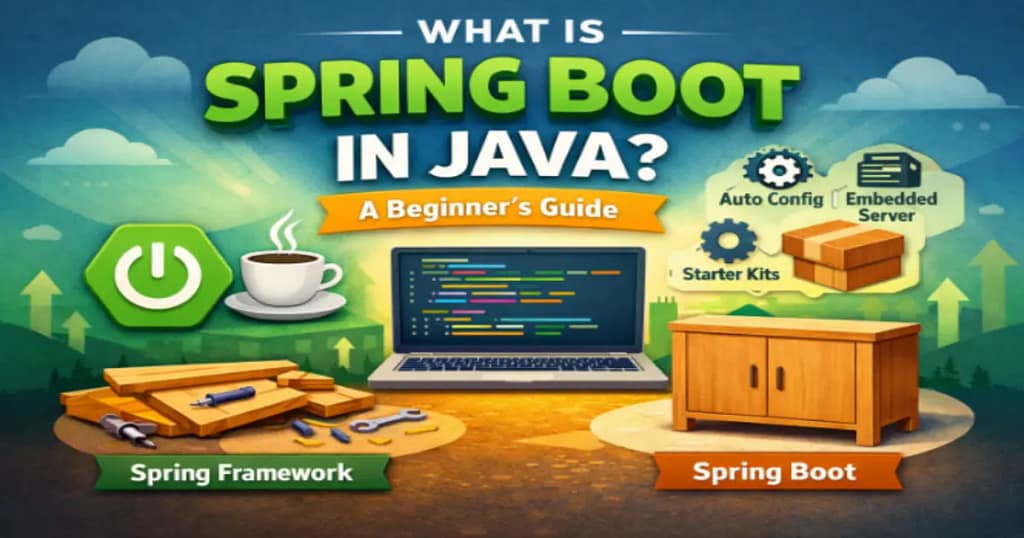
Real-World Analogy: Spring vs Spring Boot
A simple analogy makes this easier to understand.
Spring Framework
Think of Spring as IKEA furniture parts.
You get everything you need:
Screws
Wooden panels
Tools
Instructions
But you still need to assemble everything yourself.
Spring Boot
Spring Boot is like pre-assembled furniture.
You just take it out of the box and start using it.
Most of the complex setup is already done for you.
This is exactly what Spring Boot does for Java developers.
Why Was Spring Boot Created?
Before Spring Boot, building Java applications required extensive configuration.
Developers had to:
Configure web servers
Write complex XML files
Manually add dependencies
Manage application setup
This made development slower and more complicated.
Spring Boot solved these problems by introducing the following:
Auto-configuration
Embedded servers
Starter dependencies
Opinionated defaults
These features drastically reduced development time.
Simple Spring Boot Learning Path
Beginner → Core Java → Spring Basics → Spring Boot → REST APIs → Microservices
Key Features of Spring Boot
1. Auto-Configuration
One of the most powerful features of Spring Boot is auto-configuration.
Spring Boot automatically configures your application based on the dependencies you add.
For example:
If you include a web dependency, Spring Boot automatically sets up:
DispatcherServlet
Spring MVC
Basic server configuration
You don’t need to configure everything manually.
This saves a lot of development time.
2. Embedded Servers
Traditional Java applications require external servers like the following:
Apache Tomcat
Jetty
WebLogic
Spring Boot includes embedded servers inside the application.
Common embedded servers include:
Tomcat
Jetty
Undertow
This means you can run your application using a single command.
Example: java -jar application.jar
No separate server installation required.
3. Starter Dependencies
Managing dependencies in large projects can be difficult.
Spring Boot solves this with starter dependencies.
Starter packages include all required libraries for specific functionality.
Examples:
spring-boot-starter-web → for web applications
spring-boot-starter-data-jpa → for database access
spring-boot-starter-security → for authentication
spring-boot-starter-test → for testing
Instead of adding multiple libraries, you add one starter.
Spring Boot handles the rest.
4. Production-Ready Features
Spring Boot provides built-in tools for production environments.
These include:
Application monitoring
Health checks
Metrics
Logging
These features help developers monitor applications in real time.
5. Microservices Support
Modern applications often use microservices architecture.
Spring Boot works extremely well for building microservices.
Developers can create:
REST APIs
Cloud applications
Distributed systems
This is one reason many companies choose Spring Boot.
Spring Boot Architecture Explained
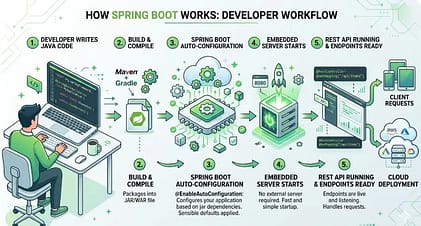
A typical Spring Boot application includes the following components.
1. Spring Boot Starter Dependencies
Provide required libraries and dependencies.
2. Spring Boot Auto-Configuration
Automatically configures application components.
3. Spring Boot CLI (Optional)
Allows running Spring applications from the command line.
4. Actuator
Provides production-ready monitoring tools.
5. Embedded Server
Runs the application without external server setup.
Simple Spring Boot Application Example
Here is a basic example of a Spring Boot application.
import org.springframework.boot.autoconfigure.SpringBootApplication;@SpringBootApplication
public class HelloApplication {
public static void main(String[] args) {
SpringApplication.run(HelloApplication.class, args);
}
}
This single file can run a complete Spring Boot application.
That’s the power of Spring Boot.
Advantages of Spring Boot
Spring Boot offers many benefits for developers and companies.
Faster Development
Develop applications quickly with minimal setup.
Reduced Configuration
Auto-configuration removes complex configuration files.
Production Ready
Built-in monitoring and health tools.
Easy Deployment
Applications run as standalone JAR files.
Large Community
Strong ecosystem and community support.
Spring Boot vs Spring Framework
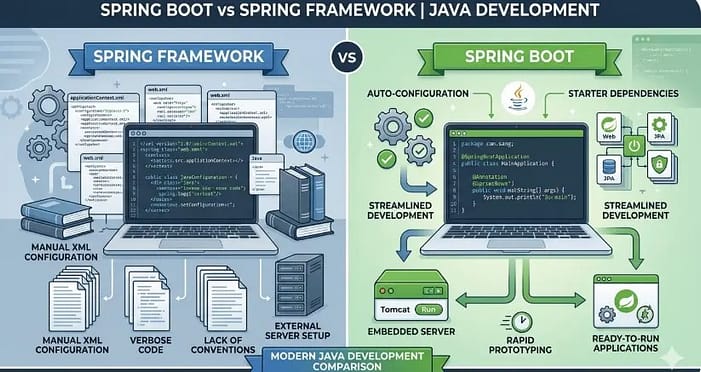
| Feature | Spring Framework | Spring Boot |
|---|---|---|
| Configuration | Complex | Minimal |
| Setup Time | Longer | Faster |
| Server Setup | External server required | Embedded server |
| Dependencies | Manual | Starter dependencies |
| Development Speed | Moderate | Very fast |
Spring Boot simplifies Spring development significantly.
My Experience Working With Spring Boot
The first time I tried building a Java web application with the traditional Spring setup, I spent more time fixing configuration errors than actually writing code. XML files, dependency conflicts, server setup — it felt like assembling furniture without the manual.
When I switched to Spring Boot, things changed quickly.
I remember creating my first API and being surprised that it actually ran with a single command. No separate server installation, no complicated setup. Just run the application, and the server starts automatically. That moment made me realize why developers prefer Spring Boot.
One practical lesson I learned: understanding the basics of what Spring Boot is doing behind the scenes really helps. Auto-configuration is great, but sometimes you need to know how to adjust it when things don’t behave as expected.
Another thing I noticed is how quickly you can prototype ideas. For small APIs or side projects, Spring Boot removes a lot of friction. You spend less time configuring tools and more time building the actual feature.
Where Is Spring Boot Used?
Spring Boot is widely used across industries.
Common use cases include:
Enterprise applications
Banking systems
REST APIs
Microservices platforms
Cloud-native applications
Backend systems
Many tech companies rely on Spring Boot for scalable systems.
Many backend portfolio projects today are built using Spring Boot APIs. Here are some Java developer portfolio projects that get you hired.
Key Takeaways
Spring Boot simplifies Java application development.
It is built on top of the Spring Framework.
Auto-configuration removes complex setup.
Embedded servers eliminate server installation.
Starter dependencies simplify dependency management.
It is widely used for APIs, microservices, and enterprise apps.
If you’re planning to become a Java backend developer, learning Spring Boot is essential and check this spring boot roadmap for fresher 2026.
FAQ
1. What is Spring Boot used for in Java development?
Spring Boot is used to build standalone Java applications, REST APIs, and microservices with minimal configuration. It simplifies the development process by providing built-in tools such as auto-configuration, starter dependencies, and embedded web servers. These features allow developers to run applications without manually setting up complex infrastructure. Spring Boot is commonly used in enterprise software, cloud applications, and backend services.
Source: Spring Official Website
2. Is Spring Boot different from the Spring Framework?
Yes, Spring Boot is built on top of the Spring Framework and acts as an extension that simplifies configuration and setup. The Spring Framework provides the core features such as dependency injection and application architecture support. Spring Boot adds opinionated defaults, starter dependencies, and embedded servers to reduce manual configuration. This allows developers to start projects faster while still using the core capabilities of Spring.
Source: Spring Documentation
3. Does Spring Boot require an external web server?
No, Spring Boot applications usually include an embedded web server such as Apache Tomcat, Jetty, or Undertow. This means developers can run applications as standalone programs without installing a separate server. The embedded server starts automatically when the application runs. However, Spring Boot applications can still be deployed to external servers if needed.
Source: Spring Boot Reference Guide
4. Do beginners need to learn Spring before learning Spring Boot?
Learning basic concepts of the Spring Framework can help understand how Spring Boot works internally. However, many beginners start directly with Spring Boot because it removes much of the configuration complexity found in traditional Spring applications. Developers can gradually learn core Spring concepts while building projects with Spring Boot. The official Spring documentation also provides beginner-friendly guides for this learning path.
Source: Spring Guides
5. Is Spring Boot suitable for building microservices?
Spring Boot is commonly used for building microservices because it simplifies creating small, independent applications. It integrates well with other tools in the Spring ecosystem, such as Spring Cloud, which provides features for distributed systems. These tools help manage service discovery, configuration, and communication between services. Many organizations use Spring Boot as part of microservice architectures.
Source: Spring Cloud Documentation
Why is Spring Boot popular?
Spring Boot is popular because it:
reduces configuration
speeds up development
includes embedded servers
supports microservices architecture
Is Spring Boot used in real companies?
Yes. Many companies use Spring Boot for enterprise applications, APIs, and microservices because it is scalable and production-ready.
External Authority References
These official resources provide deeper technical explanations and tutorials.
Discover more from GroWithMoney
Subscribe to get the latest posts sent to your email.