
You don’t fail placements because you’re not smart.
You fail because you prepare randomly.
Every year, thousands of students apply for jobs—but only a few crack them. The difference? A clear TCS NQT syllabus + smart strategy.
If you’re preparing for placements in 2026, this guide will give you exactly what to study, how to study, and what actually works.
Many students struggle with direction, especially from non-tier-1 colleges. This honest roadmap for tier-3 students explains what actually works in real placements.
TCS NQT Syllabus (What You Must Cover)
Before solving random questions, understand this:
Most companies follow a predictable pattern.
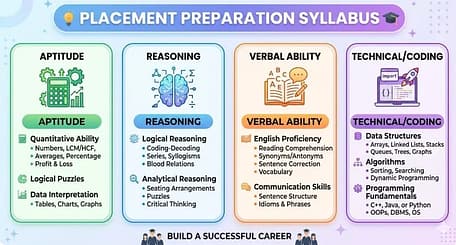
Here’s the standard syllabus:
1. Aptitude Section
Quantitative Aptitude
Data Interpretation
Basic Mathematics
2. Reasoning Section
Logical Reasoning
Analytical Thinking
Pattern Recognition
3. Verbal Ability
English Grammar
Reading Comprehension
Vocabulary
4. Technical / Advanced Section
Coding / Programming
Core Subject Knowledge
Problem Solving
Aptitude Topics You Must Master
Aptitude is the first elimination round.
Focus on these high-weightage topics:
Percentage
Profit & Loss
Time, Speed & Distance
Time & Work
Ratio & Proportion
Number System
Simple & Compound Interest
Data Interpretation (Charts, Graphs)
Pro Tip: Don’t just solve questions—track time per question. Speed matters more than difficulty.
Reasoning Topics for Placement
Reasoning tests your thinking ability—not formulas.
Important topics:
Coding-Decoding
Blood Relations
Direction Sense
Seating Arrangement
Puzzles
Syllogism
Series (Number & Alphabet)
These questions are often easy but time-consuming, so practice patterns.
Verbal Ability Topics
Many students ignore this—and lose marks.
Key topics:
Reading Comprehension
Error Detection
Sentence Correction
Para Jumbles
Synonyms & Antonyms
Fill in the blanks.
Smart Tip:
Read articles daily. It improves vocabulary + comprehension automatically.
Advanced Section (Where Most Students Fail)
This is the game-changer round.
Coding / Programming
Arrays
Strings
Recursion
Sorting & Searching
Basic DSA
Core Concepts
It depends on your branch (CS, IT, etc.)
Focus on fundamentals, not theory memorization
Companies test logic, not syntax.
If you’re confused about what to focus on in coding rounds, this DSA for placements guide explains what interviewers actually expect from freshers.
Smart Strategy (What Actually Works)

Most students follow a random plan.
Top performers follow a system.
1. Follow 80/20 Rule
20% topics = 80% questions
Focus on high-frequency topics first
2. Daily Practice Plan
1-hour aptitude
1 hour reasoning
1 hour coding
30 min reading
3. Mock Tests Are Mandatory
Take 2–3 mocks weekly
Analyze mistakes (this is where growth happens)
4. Track Weak Areas
Don’t just practice—improve weak sections daily.
5. For coding, solve this PDF question
Download TCS NQT Coding Question PDF, TCS_NQT_2026_Coding_Practice
Important Notes (Don’t Ignore This)
Consistency beats intelligence
Don’t switch resources frequently
Focus on accuracy first, then speed
Avoid burnout—take short breaks
Revision is more important than new topics
Remember: Placement is not about knowing everything. It’s about knowing the right things well.
30-Day Placement Preparation Plan
Day 1–10: Aptitude basics
Day 11–20: Reasoning + Verbal
Day 21–30: Coding + Mock tests
My Placement Journey: Mistakes, Strategy & Results
During my own placement prep, I made the classic mistake—studying everything without a plan. I would jump from aptitude to coding to English on the same day, thinking more hours meant better results. It didn’t. My mock scores stayed stuck, and that was frustrating.
The turning point came when I started following a fixed routine and tracking mistakes. I realized I was losing marks on easy questions, not tough ones. That hit hard.
One funny moment: I spent 20 minutes solving a puzzle, only to realize it was optional. Lesson learned.
What actually worked was consistency, timed practice, and revising weak areas. Once I focused on patterns instead of random questions, things started improving. Slowly, scores increased, confidence followed, and interviews felt less scary.
I still remember the relief of finally clearing that first test. It wasn’t magic, just a smarter approach and sticking to it every single day.
If you’re specifically preparing for TCS, you can check this TCS NQT 2025 complete guide for a more focused strategy and exam breakdown.
Key Takeaways
Follow a structured syllabus
Master aptitude, reasoning, and verbal basics
Practice coding for advanced rounds
Use a smart, consistent strategy
Focus on mock tests and improvement
FAQs (Frequently Asked Questions)
1. What is the typical selection process for campus placements?
Most companies follow a structured process that includes an online aptitude test, a technical assessment, and one or more interview rounds. The aptitude test usually evaluates quantitative, logical, and verbal skills. Technical rounds focus on coding, core subjects, or role-specific knowledge. The final stage is often an HR interview to assess communication and cultural fit. However, the exact process can vary depending on the company and role.
Source: Tata Consultancy Services (TCS Careers)
2. How important is aptitude in placement exams?
Aptitude is a critical part of the initial screening process in most placement tests. Companies use it to shortlist candidates efficiently from a large pool of applicants. Sections like quantitative aptitude, logical reasoning, and verbal ability are commonly included. Performance in this round often determines whether a candidate moves to the next stage. However, final selection also depends on technical and interview performance.
Source: GeeksforGeeks
3. Is coding mandatory for all placement roles?
Coding is mandatory for most technical roles such as software development or IT positions. Companies typically assess programming skills through coding tests or technical interviews. However, for non-technical roles like business operations or support roles, coding may not be required. The requirement depends on the job profile and company expectations. Candidates should review job descriptions carefully before preparing.
Source: Infosys Careers
4. How can candidates improve their performance in placement tests?
Improvement generally comes from consistent practice and analyzing mistakes. Practicing mock tests helps candidates understand exam patterns and manage time effectively. Reviewing incorrect answers is important to identify weak areas. Many platforms also provide topic-wise practice for focused improvement. There is no single method that works for everyone, so preparation strategies may vary.
Source: IndiaBix
5. How much time is usually required for placement preparation?
The time required depends on the candidate’s current skill level and consistency. Many experts suggest that 3 to 6 months of focused preparation is sufficient for most placement exams. This typically includes daily practice of aptitude, reasoning, and technical topics. However, there is no official standard duration confirmed by companies. Preparation timelines can vary based on individual learning pace.
Source: Naukri Learning
References and Guide For Preparation
Official aptitude platforms: IndiaBix GeeksforGeeks
Coding practice sites (LeetCode, HackerRank)
Discover more from GroWithMoney
Subscribe to get the latest posts sent to your email.