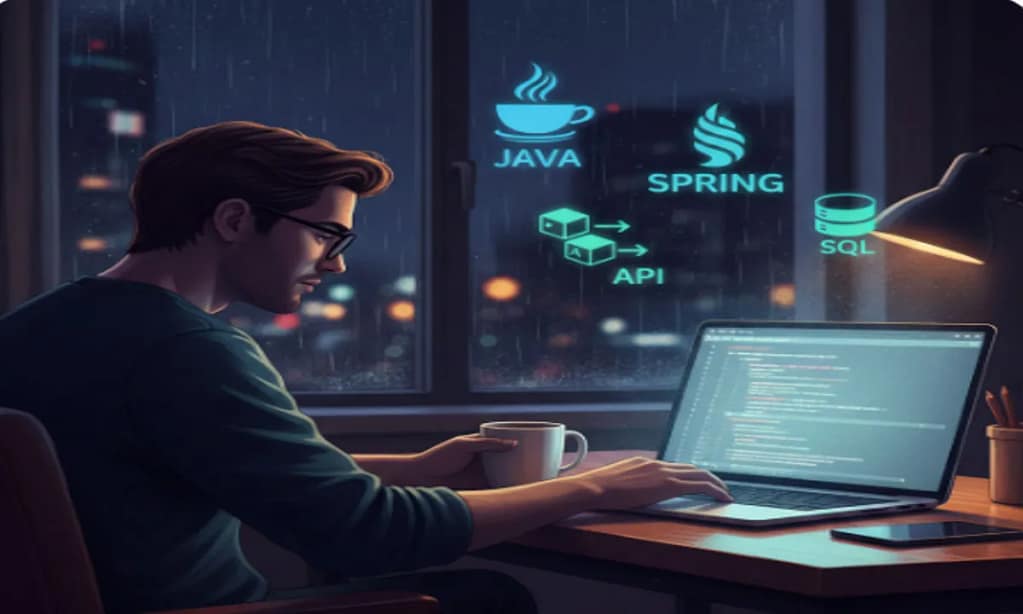
I didn’t hate Java.
I was just tired.
Tired of studying every day and still not getting a job.
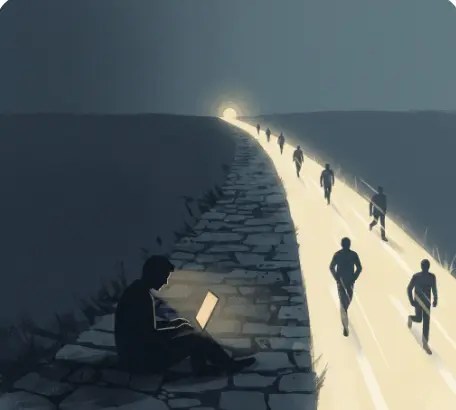
Tired of seeing others move ahead while I stayed stuck.
One night, I seriously thought, “Maybe Java is not for me.”
That moment didn’t come suddenly.
It came slowly, after months of trying.
How I Entered Java Without Overthinking
I started learning Java in 2023.
Not because of trends.
Not because of salary videos.
In college, we had a subject called OOPS in Java.
For the first time, programming felt structured to me.
Classes, objects, logic—it made sense.
So I continued.
First, core Java.
Then DSA in Java.
Then Spring.
Then Spring Boot.
Step by step, I entered deep into the Java world without realizing how deep it actually was.
At that time, I felt confident.
I thought I was doing the right thing.
Mistake 1: I Thought “Hard = Valuable”

What I thought
Java is hard.
So fewer people will do it.
So companies will value it more.
Simple logic. At least in my head.
What went wrong
Java is not just hard.
It is broad.
Every time I felt “done,” something new appeared.
Collections → Concurrency
Spring → Spring Boot
JPA → Hibernate
REST → Microservices
There was no finish line.
Real-life proof
I prepared almost everything.
Still got rejected for one missing concept.
One interview ended with
“You are good, but we need someone with more depth.”
That one line stayed with me.
What I learned
Hard doesn’t always mean faster results.
Sometimes it just means a longer road.
And freshers don’t always have time for long roads.
That realization hurt.
Mistake 2: I Compared My Journey With MERN Friends
This was the worst part.
What I thought
Everyone’s journey is different.
I should focus on myself.
What went wrong
My friends started getting jobs.
Most of them were from the MERN stack.
They built 2–3 projects.
Learned fast.
Got selected.
Meanwhile, I was still revising Java concepts.
Real-life proof
One friend got placed.
Then another.
Then another.
And I was still applying daily.
Same resume.
Same rejection mails.
What I learned
Comparison doesn’t just hurt motivation.
It silently changes how you see yourself.
I started feeling slow.
Not incapable—just slow.
And that feeling is dangerous.
Mistake 3: I Thought Effort Guarantees Outcome
What I thought
If I do DSA daily,
Build projects,
Learn Spring deeply,
I will surely get a job.
What went wrong
Effort does not equal opportunity.
Java interviews expect breadth and depth.
Freshers rarely have both.
Real-life proof
I solved problems on LeetCode.
Built APIs.
Read documentation.
Still, one small gap was enough to reject me.
Sometimes it was system design.
Sometimes SQL.
Sometimes just confidence.
What I learned
For freshers, effort is necessary—but not sufficient.
Market timing matters.
Stack demand matters.
No one talks about this honestly.
Mistake 4: I Treated Java Like a Syllabus
What I thought
Finish topics → revise → move on.
Just like college.
What went wrong
Java is not a syllabus.
It’s an ecosystem.
I was learning about Java, not with Java.
Real-life proof
I could explain concepts.
But when asked to design something simple, I froze.
Theory didn’t translate into confidence.
What I learned
Knowing is not the same as building.
Google search taught me more than any notes.
Debugging taught me more than tutorials.
That changed my approach.
The Silent Struggle Nobody Sees
This part is hard to admit.
At night, doubts came quietly.
“Why am I slower than others?”
“Did I choose the wrong stack?”
“Am I wasting time?”
Family didn’t say much.
But expectations were always there.
Every rejection felt personal.
Not loud pain.
Silent pressure.
I wasn’t lazy.
I was exhausted.
And that exhaustion made me think about quitting Java completely.
Mistake 5: I Thought Switching Stacks Was Easy
What I thought
I’ll just move to another stack.
Everyone is doing it.
What went wrong
Switching is not free.
It costs time.
Mental energy.
Confidence.
Real-life proof
I realized other stacks need at least 3 months.
I didn’t have that luxury.
Starting from zero again scared me more than staying.
What I learned
Sometimes continuing is not stubbornness.
It’s practicality.
Staying doesn’t mean you failed.
It means you’re choosing your battles.
Mistake 6: I Ignored My Own Pace
What I thought
I should be faster.
Others are faster.
What went wrong
Rushing made me forget basics.
Slowing down made me feel guilty.
Real-life proof
When I solved problems calmly using Google and LeetCode,
I understood better.
When I rushed, I remembered nothing.
What I learned
Speed comes after clarity.
Not before.
Java rewards patience, not panic.
That was a hard lesson.
Mistake 7: I Took Rejections Personally
What I thought
Rejection means I’m not good enough.
What went wrong
Every “no” added weight to my chest.
Real-life proof
I saw candidates with less knowledge getting selected.
Not because they were better —
but because the timing matched.
What I learned
Rejections are not a report card.
They are just mismatches.
Understanding this reduced the pain.
What I’m Doing Now (Honestly)
I didn’t quit Java.
Not because I love it blindly.
But because switching now costs more.
I changed how I learn.
Less chasing.
More building.
More revision.
More real-world thinking.
Still learning.
Still applying.
But with less noise in my head.
Soft Takeaways (Not Advice)
If you’re a fresher learning Java:
Feeling tired doesn’t mean you’re weak
Java is slow, not useless
Comparison steals clarity
Being slow is not a crime
Depth takes time—accept it
Switching stacks is not magic
Google is not cheating
Exhaustion is real
A Gentle Ending
If you’re thinking of quitting Java today,
Pause.
Not to motivate yourself.
Not to push harder.
Just to understand why you feel tired.
Sometimes the problem is not Java.
It’s the pressure around it.
I’m still here.
Still learning.
Not confident.
Not hopeless either.
Just continuing—one day at a time.
And maybe, that’s enough for now.
Written by a CSE graduate learning Java and backend development, sharing real fresher struggles without filters.
Read More
Java is worth is or Not
Learn Java Still No Job
Java project for Fresher
Discover more from GroWithMoney
Subscribe to get the latest posts sent to your email.