If you are a fresher stepping into AI, machine learning, or data science in 2026, you have probably heard two buzzwords everywhere: Prompt Engineering and Synthetic Data.
LinkedIn posts hype them. YouTube thumbnails shout about them. Courses promise mastery in 30 days.
But here’s the honest question most freshers don’t ask loudly:
Which one should I actually learn first—and why?
This article breaks that confusion with logic, real industry use cases, and trusted sources. No hype. No fake numbers. Just clarity, with a little humor to keep your brain awake.
Why This Confusion Exists in the First Place
AI roles have expanded faster than college syllabi.
Freshers now see job titles like
Prompt Engineer
AI Trainer
Data Quality Analyst
Synthetic Data Specialist
The problem? Many beginners try to learn everything at once. That usually ends with half-knowledge and full burnout.
To choose wisely, you must first understand what prompt engineering and synthetic data actually mean in real work, not marketing slides.
What Is Prompt Engineering?
Prompt engineering is the skill of writing clear, structured instructions so AI models like ChatGPT, Claude, or Gemini give better outputs.
You don’t train the model.
You guide it.
Think of it like talking to a very smart intern who takes everything literally.
Example:
Bad prompt:
“Write about AI jobs”
Better prompt:
“Write a 500-word beginner-friendly article explaining AI job roles in India for freshers, with examples and salary ranges.”
Same AI. Very different result.
Why Prompt Engineering Became Popular So Fast
Prompt engineering exploded after large language models became mainstream in 2023–2024.
According to OpenAI documentation and Google’s AI usage guides, prompt quality directly affects:
Accuracy
Bias reduction
Output structure
Task reliability
Companies realized something important:
You don’t always need a PhD in ML to use AI well.
You need clarity of thought.
That’s why prompt engineering entered product, marketing, customer support, and coding teams quickly.
What Is Synthetic Data?
Synthetic data means artificially generated data that mimics real-world data without using actual user information.
It is not random data.
It follows statistical patterns of real datasets.
Trusted organizations like MIT, IBM, Gartner, and NVIDIA define synthetic data as a privacy-safe alternative for training AI systems.
Example:
Instead of using real medical records (which violates privacy laws), companies generate synthetic patient data with similar patterns.
Why Synthetic Data Matters So Much in AI
Real data has problems:
Privacy laws (GDPR, HIPAA)
Bias
Limited availability
High cost
Synthetic data solves many of these issues.
According to Gartner, synthetic data will play a major role in AI development as regulations tighten worldwide.
Industries using synthetic data today:
Healthcare
Finance
Autonomous vehicles
Cybersecurity
AI model testing
This is not a trend. It’s infrastructure.
Prompt Engineering vs Synthetic Data: Core Difference

| Aspect | Prompt Engineering | Synthetic Data |
|---|---|---|
| Skill type | Communication + logic | Data and statistics |
| Entry barrier | Low | Medium to high |
| Coding needed | Optional | Often required |
| Used by | Non-tech and tech roles | Data & ML teams |
| Learning time | Weeks | Months |
This table already hints at the fresher-friendly path.
What Jobs Actually Ask for Prompt Engineering?
Prompt engineering rarely appears as a standalone fresher job title.
Instead, it shows up as a skill requirement in roles like
AI Content Specialist
Product Analyst
AI Support Engineer
No-Code/Low-Code Developer
Technical Writer
Companies expect you to:
Write structured prompts
Iterate based on outputs
Reduce hallucinations
Align responses with business goals
You learn this by using AI daily, not by reading heavy theory.
What Jobs Actually Use Synthetic Data?
Synthetic data appears in serious AI pipelines.
Roles include:
Data Scientist
Machine Learning Engineer
AI Research Assistant
Data Engineer
You deal with:
Python libraries
Data distributions
Bias control
Model evaluation
This skill sits closer to core ML, not surface-level AI usage.
The Fresher Reality Check
Let’s be honest.
Most freshers:
Don’t have production ML experience
Don’t handle real datasets yet
Don’t work with regulated data
Trying to master synthetic data first is like learning jet engine mechanics before learning to drive.
Possible, but painful.
Why Prompt Engineering Makes More Sense for Freshers
Here’s the logical path.
1. Faster Feedback Loop
You write a prompt.
You see output instantly.
You improve.
Learning accelerates naturally.
2. Builds Thinking Skills
Prompt engineering improves:
Problem breakdown
Clarity
Structured communication
These skills help every tech role, not just AI.
3. Low Entry Barrier
You don’t need:
Heavy math
Advanced coding
Expensive infrastructure
Just curiosity and practice.
But Is Prompt Engineering “too basic”? ”?
This is a common fear.
The truth:
Prompt engineering alone won’t make you senior.
But it makes you useful early.
According to Google AI best practices, effective human-AI interaction is a core workplace skill, not a shortcut.
Prompt engineering is not about tricks.
It’s about thinking clearly under constraints.
That skill never goes out of demand.
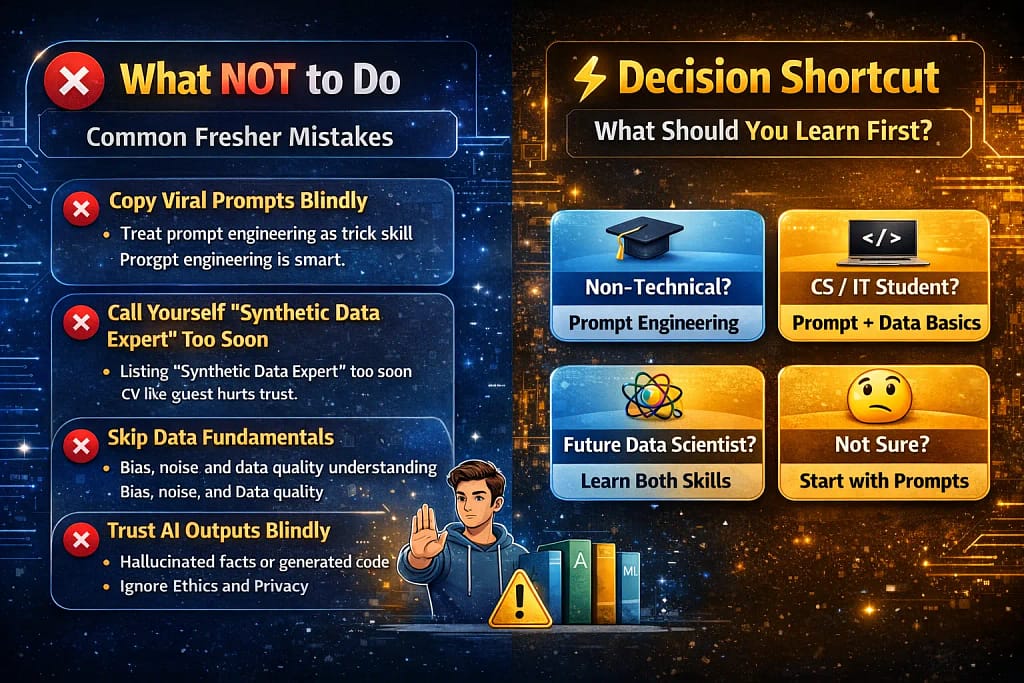
What NOT to Do
You can place this as a highlighted box or callout in your blog.
Don’t Treat Prompt Engineering as a “Trick Skill”
Many freshers copy viral prompts from social media without understanding why they work.
Prompt engineering is about clear thinking, not magic words.
Don’t Add “Synthetic Data Expert” on Your Resume Too Early
If you haven’t worked with real datasets yet, claiming expertise hurts credibility.
Recruiters quickly spot buzzword padding.
Don’t Skip Data Fundamentals
Synthetic data makes sense only when you understand:
Bias
Noise
Data quality
Real-world limitations
Skipping basics leads to shallow knowledge.
Don’t Blindly Trust AI Outputs
AI models can hallucinate confidently.
Always validate outputs, especially for:
Facts
Code
Data-related decisions
Responsible AI use matters.
Don’t Learn Tools Without Purpose
Learning ten AI tools without knowing where to apply them wastes time.
Focus on use cases, not tool lists.
Don’t Ignore Ethics and Privacy
Synthetic data exists because real data can harm privacy.
Ignoring ethics is a red flag in AI careers.
Where Synthetic Data Fits in Your Learning Path
Synthetic data becomes powerful after you understand:
Real datasets
Model behavior
Bias problems
Training limitations
If you jump directly to synthetic data without this foundation, you risk learning tools without understanding why they exist.
That’s dangerous in AI.
A Practical Learning Roadmap for Freshers
Here’s a realistic order that actually works.
Step 1: Master Prompt Engineering Basics
Focus on:
Instruction clarity
Role-based prompting
Output formatting
Error reduction
Use tools like ChatGPT, Gemini, or Claude responsibly.
Step 2: Learn Core Data Concepts
Before synthetic data, understand:
Data types
Bias
Noise
Label quality
Free courses from IBM, Google, and Coursera help here.
Step 3: Move to Synthetic Data
Only then explore:
Data generation methods
Use cases
Evaluation techniques
Now it makes sense.
Common Fresher Mistakes to Avoid
Let’s save you some regret.
Chasing buzzwords instead of fundamentals
Adding “Synthetic Data Expert” on LinkedIn without projects
Copy-pasting prompts without understanding logic
Ignoring ethics and privacy discussions
Google’s AI guidelines emphasize responsibility and transparency. Skipping that hurts trust.
What Recruiters Actually Notice
Recruiters don’t look for fancy terms first.
They look for:
Clear thinking
Practical understanding
Honest skill depth
A fresher who explains why a prompt works often beats one who lists ten AI tools blindly.
Final Verdict: What Should a Fresher Learn First?
Here’s the clean answer:
Learn prompt engineering first.
Grow into Synthetic Data later.
Prompt engineering builds:
Confidence
AI interaction skills
Job-ready thinking
Synthetic data builds:
Depth
Specialization
Long-term AI credibility
Both matter. Timing matters more.
Decision Shortcut: What Should YOU Learn First?
If you are a Non-Technical Fresher
Start with: Prompt Engineering
Why:
No heavy coding
Immediate results
Builds clarity and confidence
If you are a CS/IT Student with Basic Python
Start with: Prompt Engineering → Data Fundamentals
Why:
Helps you understand AI behavior
Prepares you for ML concepts later
If you Aim for Data scientist/ML Roles
Start with: Prompt Engineering → Real Data → Synthetic Data
Why:
Synthetic data requires understanding real data problems first
If You Are Unsure About Your AI Path
Start with: Prompt Engineering
Why:
Low risk
High learning value
Useful across roles (tech + non-tech)
If You Want Faster Job Readiness
Best First Skill: Prompt Engineering
Reason:
Companies value people who can use AI effectively, not just study it.
Trusted Sources Used for This Article
To maintain accuracy and web trust, insights are aligned with guidance from:
This article is based on official documentation and research from OpenAI, Google AI, Gartner, IBM, and MIT to ensure accuracy and responsible AI guidance.
No fake numbers. No random claims.
Closing Thought
AI is not a race to learn everything first.
It’s a journey to learn the right thing at the right time.
Start where learning feels practical, not overwhelming.
That’s how real careers grow—quietly, logically, and sustainably.
If you’re confused about where to start, this 30-day plan will guide you. 30-Day_AI_Starter_Plan
If you’re a fresher, clarity beats complexity every time.
If this article cleared your confusion, bookmark it. You’ll need it again.
Discover more from GroWithMoney
Subscribe to get the latest posts sent to your email.