I still remember the day I opened my Java notes and felt blank.
Not because Java was hard.
But because I had seen everything and understood nothing.
Everyone around me was “learning fast.”
I was watching videos, saving playlists, and still feeling behind.
This is not a success story.
This is a mistake story.
And yes, I made most of them myself.
A little about me (so you know where this is coming from)
I’m a BE CSE student from a tier-3 government college, 2025 batch.
Currently in my 3rd year.
Like many of us, I didn’t start Java because I loved it.
I started because placements were coming and Java was “important.”
I watched YouTube.
I followed roadmaps.
I trusted seniors and creators.
And still… I messed up.
These are the 7 mistakes I see most freshers make while learning Java.
I made 4 of them myself.
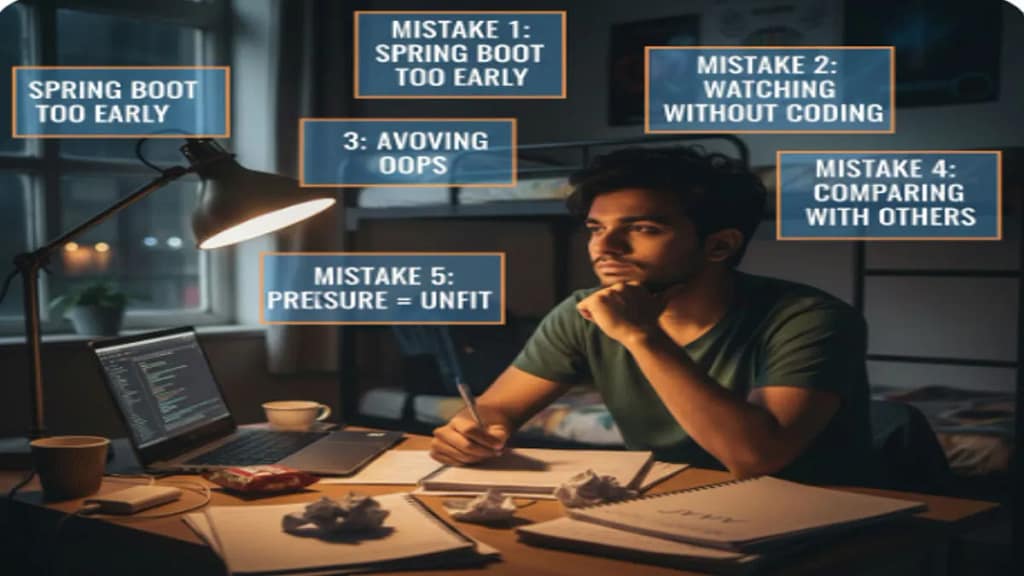
Mistake 1: Jumping to Spring Boot before learning Java basics
What I thought:
“If people are building real projects with Spring Boot, I should do that too.”
I saw a video from Learn Code With Durgesh saying you can learn Spring Boot without learning Spring first.
It sounded logical.
It sounded fast.
It sounded smart.
So I jumped.
What went wrong:
I didn’t even understand why the code was written.
Annotations felt like magic words.
Errors felt personal.
Whenever something broke, I had no idea where to look.
Real-life proof:
I could run a Spring Boot project, but I couldn’t explain:
What a class actually does
Why a constructor exists
How objects work
I wasn’t learning.
I was copying.
What I learned:
Frameworks hide complexity.
And when you don’t know the basics, they hide learning too.
Now I know:
If core Java is weak, Spring becomes noise.
Sometimes the problem isn’t Java.
It’s the order we choose to learn it.
Mistake 2: Watching tutorials without coding anything
This one hurts to admit.
What I thought:
“If I watch carefully, I’ll understand. Practice can come later.”
So I watched videos.
Long videos.
Full playlists.
I felt productive.
But I never opened my IDE.
What went wrong:
Watching created a fake sense of progress.
When I tried to write code on my own… my mind went empty.
Real-life proof:
Ask me to explain a concept? I could try.
Ask me to code it? I froze.
Because understanding without doing is fragile.
What I learned:
Coding is not a spectator sport.
Now I practice problems on LeetCode and GeeksforGeeks, even if I fail.
Failing while coding teaches more than watching success stories.
There’s a silent gap between “I’ve seen this” and “I can do this.”
Most freshers live in that gap.
Mistake 3: Avoiding OOPS because it felt too hard
What I thought:
“OOPS is confusing. I’ll skip it for now.”
Classes, objects, inheritance, abstraction—it felt heavy.
So I ignored it.
What went wrong:
Java is OOP.
Every time I avoided it, confusion increased.
Real-life proof:
I couldn’t understand:
Why code was structured this way
Why methods were placed inside classes
Why interviewers kept asking OOPS questions
Because I never faced it properly.
What I learned:
OOPS feels hard only until you sit with it slowly.
Avoiding it doesn’t save time.
It creates fear.
At some point, skipping basics stops feeling like freedom
and starts feeling like panic.
Mistake 4: Comparing myself with a faster batchmate
This one damaged my confidence the most.
What I thought:
“He can do it. Why can’t I?”
One of my batchmates was learning fast.
He solved problems.
He spoke confidently.
Every comparison pushed me down.
What went wrong:
I stopped seeing my own progress.
Every small win felt useless because someone else was ahead.
Real-life proof:
Instead of coding, I kept thinking:
“Maybe I’m not made for this.”
Confidence dropped.
Fear increased.
What I learned:
Comparison doesn’t motivate.
It paralyzes.
Everyone has a different start, pace, and background.
Mistake 5: Believing pressure means I’m not fit for IT
This hit me during TCS NQT.
My first interview.
What I thought:
“I know basics. I’ll manage.”
What went wrong:
The questions were easy.
But my mind wasn’t.
Due to pressure, I couldn’t speak.
I blanked.
Real-life proof:
I walked out thinking:
“Maybe coding and IT are not for me.”
That one moment decided my self-image for weeks.
What I learned:
Interview pressure ≠ skill level.
It just means you need exposure, not a career change.
The silent struggle no one talks about
This is not about Java.
This is about what runs in the background.
Self-doubt.
Family pressure.
Placement fear.
Feeling “I started too late.” ”.
All of them hit me.
They still do.
Every time someone asks, “Placement ka kya scene hai?”
Something tightens inside.
You don’t say it out loud.
But it affects how you learn.
Where I am now (not perfect, just honest)
I’m still learning Java.
Still practicing.
Still failing.
But now I:
Code more than I watch
Face OOPS instead of avoiding it
Practice problems regularly on LeetCode and GFG
Accept fear instead of fighting it
I’m not ahead.
But I’m moving.
Soft takeaways (not advice, just experience)
Basics are slow but permanent
Practice feels boring until it clicks
OOPS is scary only once
Interviews test calm, not intelligence
Comparison kills confidence quietly
A gentle ending
If you’re a fresher struggling with Java, you’re not weak.
You’re just early in the journey.
I’m not done yet.
You’re not late.
We’re just learning—slowly, honestly, imperfectly.
And that’s okay.
Disclaimer
This article is based on personal learning experience as a student. It does not guarantee placements or results. Learning outcomes vary based on effort, consistency, and individual background.
Written by a BE CSE (2025) student from a tier-3 government college, sharing real Java learning mistakes, interview experiences, and fresher struggles—no hype, no shortcuts.
Discover more from GroWithMoney
Subscribe to get the latest posts sent to your email.