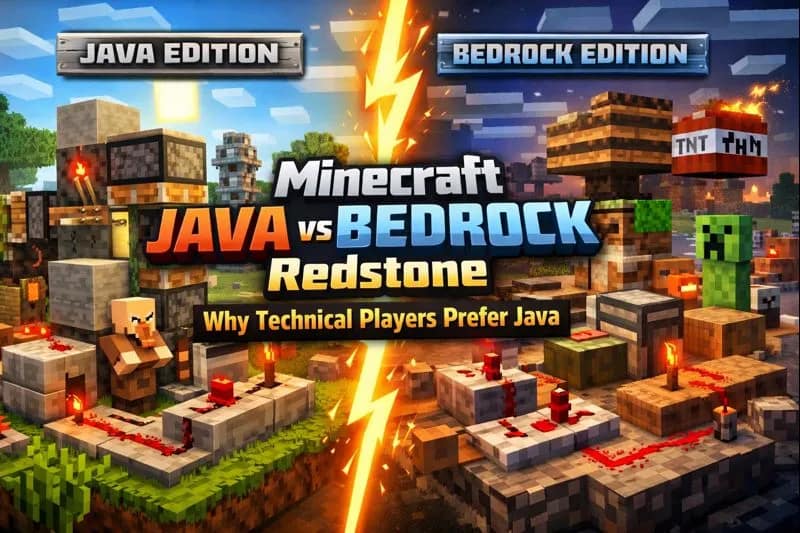
Redstone is the brain of Minecraft. It powers farms, doors, machines, and some frankly ridiculous contraptions that feel closer to engineering than gaming.
When players compare Minecraft Java vs Bedrock redstone, the debate usually isn’t about graphics or performance. It’s about logic, predictability, and control. And that’s where technical players draw a very clear line.
This article explains—calmly, clearly, and without hype—why advanced redstone players consistently choose Java Edition. No myths, no drama, just how the game actually works.
Understanding Redstone at a Technical Level
Redstone isn’t just “on or off.” It’s a system of updates, ticks, power levels, and block interactions that follow strict internal rules.
For casual players, both editions feel similar. A lever opens a door. A button triggers a piston.
For technical players, the details matter:
Update order
Timing precision
Block behavior consistency
Repeatability across worlds and versions
These details decide whether a farm produces 1,000 items per hour—or breaks randomly.
This is where Java and Bedrock diverge.
Redstone Consistency: Java’s Biggest Advantage
Deterministic Behavior in Java Edition
Java Edition redstone follows deterministic rules. That means the same redstone build behaves the same way every time, as long as conditions are identical.
If a machine works in one Java world, it will:
Work on another Java world
Work on another Java server
Keep working after reloads and restarts
For technical players, this predictability is non-negotiable.
Redstone in Java processes block updates in a consistent order. This allows players to design extremely precise machines that depend on exact timing.
Predictability is not a bonus feature. It is the foundation of technical gameplay.
Bedrock’s Randomized Update Order
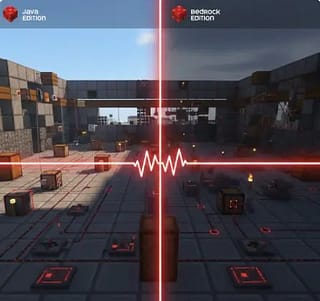
Bedrock Edition uses a non-deterministic update system in several redstone scenarios.
In simple terms:
Redstone dust updates can occur in different orders
Pistons may fire differently under the same setup
Machines can behave inconsistently after chunk reloads
Mojang designed this system to improve performance across devices, especially consoles and mobile. That design choice makes sense—but it comes with trade-offs.
For advanced redstone builds, randomness equals risk.
Why Consistency Matters in Complex Builds
Small inconsistencies don’t matter in a basic door.
They matter a lot in:
Multi-module farms
Redstone computers
Item sorters with overflow protection
Flying machines
Tick-perfect contraptions
Java redstone allows players to build once and scale safely. Bedrock redstone often requires workarounds or simplifications.
Bugs vs Features: A Controversial but Critical Difference
Java’s “Quasi-Connectivity” Explained
Java Edition includes a mechanic called quasi-connectivity (QC). It allows pistons and droppers to be powered indirectly under specific conditions.
Technically speaking, QC is a bug inherited from early Java versions.
Practically speaking, it’s one of the most powerful redstone tools ever created.
Java players didn’t just accept QC—they mastered it.
It enables:
Compact piston logic
Advanced door designs
Efficient farm triggering
Cleaner wiring layouts
Because QC has existed for over a decade, Mojang treats it as intended behavior in Java.
Bedrock Removes These “Bugs” by Design
Bedrock Edition intentionally removes:
Quasi-connectivity
Certain update order exploits
Some block interaction edge cases
From a software perspective, this is clean design.
From a technical gameplay perspective, it removes entire categories of machines.
Many Java tutorials simply cannot be recreated in Bedrock without the following:
Extra space
Additional components
Lower efficiency
This isn’t about one edition being “broken.” It’s about how much freedom the system allows.
Stability Over Time
Java redstone mechanics rarely change without warning. Mojang avoids breaking technical builds unless absolutely necessary.
Bedrock redstone has seen more mechanical adjustments over time, often to improve parity or fix inconsistencies.
For players who invest hundreds of hours into a single world, long-term stability matters.
Farms & Automation: Where Java Dominates
Mob Farms and Spawning Control
Java Edition uses deterministic mob spawning rules tied closely to player position and tick rates.
This allows technical players to:
Calculate spawn rates accurately
Design highly efficient mob farms
Stack spawning platforms with precision
Bedrock uses a different spawning system based on density caps per area, which behaves less predictably in practice.
The result:
Java farms are easier to optimize
Bedrock farms require more trial and error
Iron Farms: A Clear Case Study
Iron farms highlight the Java vs. Bedrock redstone divide perfectly.
Java iron farms rely on the following:
Villager panic mechanics
Consistent workstation linking
Predictable golem spawning
Once built correctly, they run for years without maintenance.
Bedrock iron farms:
Depend on village center mechanics
Are sensitive to small changes
Can break due to subtle updates or movement
Both are functional. Only one is fully predictable.
Automation at Scale
Large-scale automation needs:
Reliable item transport
Exact hopper timing
Predictable piston behavior
Java’s redstone tick system enables this precision.
That’s why.
Most industrial-scale farms exist in Java
Most redstone world records come from Java
Most technical servers choose Java
This isn’t preference. It’s practicality.
Technical Gameplay Impact
Community Knowledge and Tooling
Java redstone benefits from:
Over a decade of documentation
Extensive testing by technical communities
Tools like Carpet Mod for analysis
Deep wiki coverage and code-level explanations
Technical players rely on shared knowledge. Java offers the richest ecosystem.
Bedrock’s community is growing, but the documentation depth is not yet comparable.
Modding and Redstone Testing
Java Edition supports:
Simulation mods
Tick analysis tools
Redstone debuggers
Controlled test environments
These tools allow players to understand why something works—not just that it works.
For technical players, understanding mechanics matters as much as using them.
Competitive and Experimental Play
When players push Minecraft beyond survival—into computing, automation theory, or engineering simulations—Java is the default platform.
Not because Bedrock is bad.
Because Java offers:
More control
More predictability
Fewer unknown variables
That’s what technical players need.
Minecraft Java vs Bedrock Redstone: Final Verdict
The Minecraft Java vs Bedrock redstone debate isn’t about superiority. It’s about intent.
Bedrock prioritizes accessibility, performance, and cross-platform play.
Java prioritizes depth, consistency, and technical freedom.
Technical players choose Java because
Redstone behaves consistently
“Bugs” function as powerful tools
Automation scales reliably
Mechanics remain stable long-term
Quick Comparison Table
| Feature | Java Edition | Bedrock Edition |
|---|---|---|
| Redstone consistency | Predictable | Partially random |
| Update order | Deterministic | Non-deterministic |
| Quasi-connectivity | Available | Not available |
| Large-scale farms | Highly reliable | More limited |
| Technical builds | Preferred | Restricted |
If your goal is casual survival, both editions work beautifully.
If your goal is precision engineering inside a block game, Java simply offers a stronger foundation.
Which edition is better for technical players? Check Here
FAQ
Is Java redstone really more consistent than Bedrock?
Yes. Java uses a deterministic update system, which makes redstone behavior predictable and repeatable.
Can Bedrock redstone farms match Java efficiency?
Some can, but many Java farms rely on mechanics that Bedrock doesn’t support.
Will Mojang ever unify redstone mechanics?
Mojang aims for feature parity, but redstone systems are deeply different by design.
Trusted Sources & References
This article is based on official Minecraft documentation, long-standing Java mechanics, and widely accepted technical community knowledge.
Discover more from GroWithMoney
Subscribe to get the latest posts sent to your email.
Pingback: Powerful Facts About Minecraft Java Edition 2026 Every Player Should Know