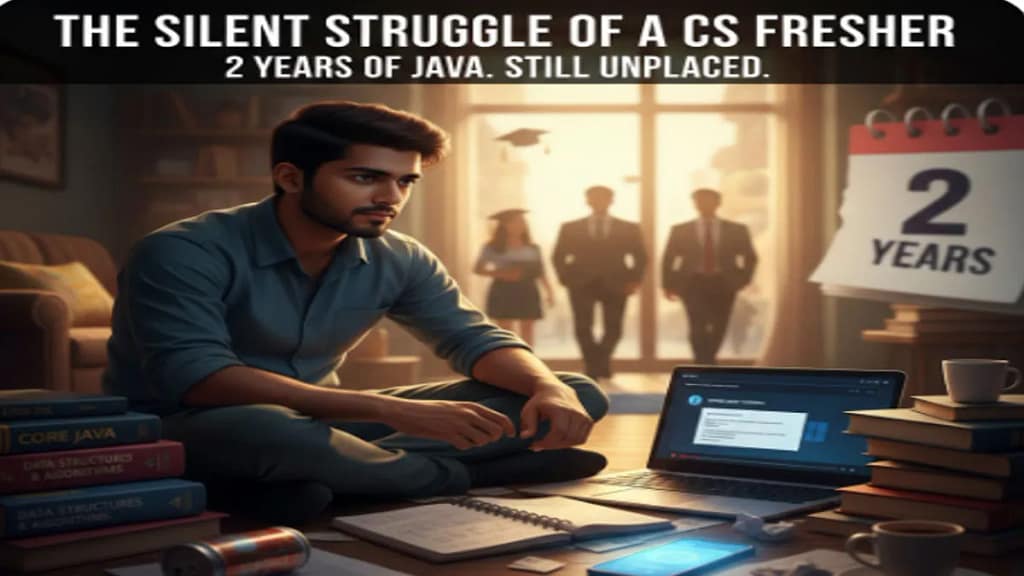
For two years, my life revolved around Java.
Every morning started with DSA.
Every night ended with Spring Boot videos.
Still, I was sitting at home, unplaced,
watching others move ahead.
That silence after “I’ve learned everything”
hurts more than any rejection.
Where This Story Comes From
I’m a CS fresher from a regular Indian college.
Not a topper.
Not from a famous campus.
Just someone who believed that if I stayed consistent,
A job would eventually come.
I spent almost two years learning Java seriously—
Core Java, DSA, and Spring Boot.
I applied everywhere.
TCS. Infosys. Cognizant and other company.
Almost every role is related to my field.
Yet after multiple coding tests and interviews,
Nothing converted.
That’s when I realized something important.
Learning Java wasn’t the problem.
How I learned—and what I ignored—was.
Mistake 1: I Believed “Everything in Java” Could Be Finished
What I Thought
Once I complete Java, DSA, and Spring Boot,
I’ll be job-ready.
I treated learning like a syllabus.
Finish topics.
Revise.
Move on.
What Went Wrong
No matter how much I learned,
One feeling never left.
Something is still missing.
Even after two years,
I never felt “ready.”
Real Experience
In coding tests like Infosys DSE/SP and TCS NQT,
The questions didn’t test how much I remembered.
They tested how I thought.
I knew the concepts.
But connecting them under pressure was hard.
What I Learned
Java doesn’t end.
There is no “complete.”
Real learning starts when you stop chasing finish lines
and start focusing on understanding.
Mistake 2: I Did DSA Without Building Thinking
What I Thought
More DSA problems = better chances.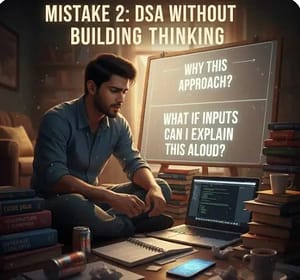
So I solved a lot.
Daily practice.
Target-based preparation.
What Went Wrong
I started recognising patterns.
not building logic.
If a question looked slightly different,
I panicked.
Real Experience
During one test, the problem was familiar
but framed differently.
I froze.
Not because it was too hard—
but because I didn’t truly own the logic.
What I Learned
DSA is not about quantity.
It’s about slowing down and asking:
Why this approach?
What if inputs change?
Can I explain this aloud?
If you can’t explain it,
You haven’t learned it deeply.
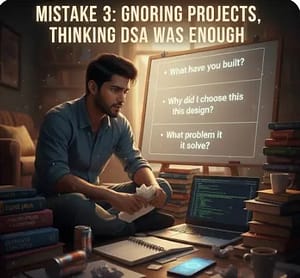
Mistake 3: I Ignored Projects, Thinking DSA Was Enough
What I Thought
Service companies focus only on coding.
Projects don’t matter much.
What Went Wrong
Interviews didn’t stop at DSA.
They asked:
What have you built?
Why did you choose this design?
What problem did it solve?
My answers felt weak.
Real Experience
I noticed something uncomfortable.
Candidates with average DSA
but real projects were more confident than me.
They had experiences to talk about.
I had a theory.
What I Learned
One small, honest project matters.
Not copied.
Not fancy.
Just something you understand completely.
That’s where confidence comes from.
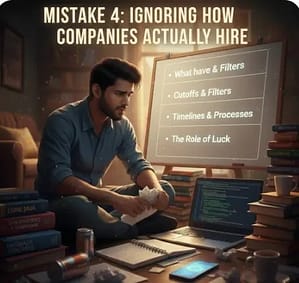
Mistake 4: I Didn’t Understand How Companies Actually Hire
What I Thought
If I’m skilled, I’ll get selected.
Merit always wins.
What Went Wrong
Hiring isn’t that simple.
There are cutoffs.
Filters.
Timelines.
Sometimes, luck.
Real Experience
I applied everywhere with the same preparation.
Some tests went well.
Some didn’t.
Many rejections came without explanation.
That silence hurt.
What I Learned
Hiring is a system.
You can’t control everything.
but you can understand patterns and prepare smarter.
Hard work matters.
So does direction.
Mistake 5: I Underestimated Communication
What I Thought
If I know the answer, that’s enough.
What Went Wrong
Pressure changes everything.
My thoughts were clear in my head.
but unclear when spoken.
Real Experience
I’ve answered questions correctly
yet walked out unsure.
The interviewer wasn’t convinced—
and I could feel it.
What I Learned
Communication isn’t about English.
It’s about clarity.
Explaining your thinking calmly
matters more than fast answers.
The Silent Struggle Nobody Talks About
This part stays inside.
Friends started getting placed.
Family started asking for updates.
Every call added pressure.
I felt late.
Like everyone was moving forward
and I was still standing still.
Self-doubt crept in:
Am I capable?
Did I waste two years?
Why is nothing working?
Some days were heavy.
And no one really talks about that.
What Slowly Changed Things for Me
Not motivation.
Not shortcuts.
Small, honest shifts:
Understanding instead of completing
Fewer problems, deeper thinking
Revising fundamentals
Accepting rejection without self-blame
Progress became quieter.
But more stable.
If You’re a Fresher Reading This
If you’ve learned Java
and still feel stuck,
You’re not behind.
You’re just early in understanding
how the industry actually works.
Learning never goes to waste.
But awareness matters.
A Real Ending
I’m still on this journey.
Still learning.
Still applying.
Still improving.
But I no longer feel broken.
Just in progress.
And sometimes,
That’s enough.
Discover more from GroWithMoney
Subscribe to get the latest posts sent to your email.