
But I was scared of choosing it.
Everywhere I looked, people were shouting:
“Java is dying.”
“Learn Node.js if you want a job.”
“AI is the future. Don’t waste time.”
And I’m a 2025 CSE graduate from a Tier-3 college.
I can’t afford wrong bets.
That fear stayed with me longer than any syntax error.
I’m not a topper.
Not from a Tier-1 college.
No fancy referrals.
I started learning Java seriously around two years ago.
Slowly. With confusion. With doubt.
I didn’t fall in love with Java.
I questioned it every month.
So when I talk about Java in 2026, this is not theory.
This is a fresher thinking out loud.
Lesson 1: I thought Java was outdated
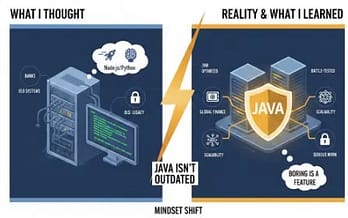
What I thought
I genuinely believed Java was only for old systems.
Banks. Legacy projects. Big companies are stuck in the past.
Everyone around me was learning Node.js or Python or jumping into AI.
Java felt… slow.
What went wrong
I stopped respecting the basics.
I treated Java like a “backup option.”
That mindset itself was the mistake.
Real-life proof
Whenever I read about security breaches, scalability issues, or system failures,
Java was still there in the solution stack.
Big systems weren’t running on hype.
They were running on stability.
What I learned
Java isn’t outdated.
It’s boring on the surface because it’s doing serious work underneath.
And serious systems don’t care about trends.
Sometimes the truth doesn’t shout.
It just stays.
Lesson 2: I believed job talk more than skill talk
What I thought
People kept saying:
“As a fresher, Node.js will give you a job faster.”
That sentence scared me.
What went wrong
I started comparing learning paths instead of learning deeply.
I watched roadmap videos more than writing code.
Real-life proof
I noticed something uncomfortable.
People saying “Node will get you a job” were also still preparing.
No one had clarity.
Everyone had opinions.
What I learned
There is no language that guarantees a job.
Only how well you understand one matters.
Java rewards depth.
And depth takes time.
Lesson 3: I underestimated Java because it wasn’t flashy

What I thought
Java didn’t feel exciting.
No instant output.
No quick dopamine.
What went wrong
I kept expecting Java to entertain me.
But Java expects discipline, not excitement.
Real-life proof
When I studied OOP concepts, memory, threading,
Things finally started making sense across all languages.
Java was teaching me how systems think.
What I learned
Java trains your brain, not your ego.
And once your thinking improves,
Learning other technologies becomes easier.
There’s a phase where learning feels slow.
That phase is not failure.
It’s a foundation.
Lesson 4: I thought AI would make Java useless
What I thought
Everyone was moving to AI.
And I felt late. Very late.
What went wrong
I confused tool popularity with system importance.
Real-life proof
AI models still need:
Backend systems
Secure APIs
Scalable infrastructure
And Java is deeply embedded there.
What I learned
AI didn’t replace Java.
It sits on top of systems built using languages like Java.
Trends come and go.
Infrastructure stays.
Lesson 5: I ignored Java’s strength in security & scalability

What I thought
Security and scalability felt like “senior topics.”
Not fresher stuff.
What went wrong
I didn’t realize these are exactly why companies trust Java.
Real-life proof
When reading about enterprise systems, payment gateways,
For large-scale platforms, Java keeps appearing.
Not because it’s cool.
Because it’s reliable.
What I learned
In 2026, when systems are growing faster than ever,
Java still has a seat at the table.
No one replaces reliability overnight.
The silent struggle no one talks about
This part is uncomfortable.
Being from a Tier-3 college,
I constantly felt behind.
Everyone online looked smarter.
Faster. More confident.
I questioned myself at night:
“Am I wasting time?”
“Am I choosing the wrong path?”
“What if Java really dies?”
The pressure wasn’t coding.
It was a comparison.
And comparison kills clarity.
So… is Java worth learning in 2026?
My honest answer?
Yes. But not blindly.
Java is still worth learning because:
When it comes to security, Java is trusted
When it comes to scalability, Java is proven
When it comes to long-term systems, Java is everywhere
But Java won’t save you if:
You learn it half-heartedly
You chase trends every month
You don’t understand fundamentals
Soft takeaways from one fresher to another
Don’t choose a language because of noise
Choose it because you can stick with it
Java rewards patience, not shortcuts
You’re not late. You’re early enough
Tier-3 doesn’t decide your ceiling
I used simple resources like YouTube and consistent practice.
Nothing fancy. Just honest effort.
A quiet ending
I don’t know everything.
I’m still learning.
But in 2026,
I no longer feel ashamed of choosing Java.
Because while trends scream,
Java quietly runs the world.
And sometimes, that’s enough.
Discover more from GroWithMoney
Subscribe to get the latest posts sent to your email.