Breaking into software development can feel overwhelming, especially if you are just starting with Java programming. You search online and see dozens of confusing roadmaps: frameworks, cloud tools, databases, containers, microservices — the list keeps growing.
The good news?
You don’t need to learn everything at once. A clear and practical Java roadmap helps you focus on the skills that actually matter for entry-level developer roles.
This guide walks through a realistic java roadmap for freshers 2026, covering core programming, backend development, tools used in modern companies, and portfolio projects that help you land your first job.
Why Java Is Still a Strong Career Choice in 2026
Despite the rise of new languages, Java remains one of the most widely used programming languages in enterprise software.
Large organizations rely on Java for:
Backend web services
Banking and fintech systems
Enterprise software
Android applications
Large-scale distributed systems
According to the Stack Overflow Developer Survey and job market reports from platforms like LinkedIn Jobs and Indeed, Java consistently ranks among the top backend languages demanded by employers.
Major companies using Java include:
Netflix
Amazon
LinkedIn
Uber
Airbnb
Because of its stability and huge ecosystem, Java skills continue to offer high-paying backend developer opportunities, especially in the US tech market.
Why Following Java Roadmap for Freshers 2026
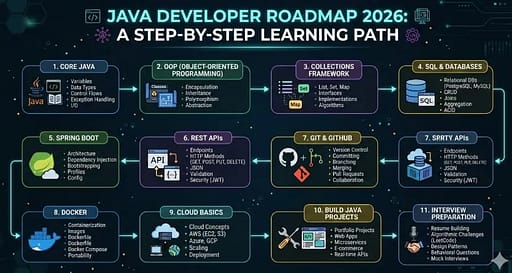
Step 1: Learn Core Java Fundamentals
Before touching frameworks or cloud tools, you must build strong Java fundamentals.
Many beginners skip this stage and struggle later with frameworks like Spring Boot.
Focus on understanding how Java actually works.
Key Core Java Topics
Learn these concepts thoroughly:
Basic Programming Concepts
Variables and data types
Operators
Conditional statements
Loops
Methods and functions
Object-Oriented Programming (OOP)
Java heavily relies on OOP.
Important principles include:
Classes and objects
Inheritance
Encapsulation
Polymorphism
Abstraction
These concepts form the foundation of almost every Java application: understand OOP concepts in Java.
Collections Framework
A large portion of backend coding involves data structures.
Key components:
ArrayList
HashMap
HashSet
LinkedList
Iterators
Understanding how collections work improves both coding performance and problem solving and basics of how Java works.
Exception Handling
Applications must handle errors safely.
Learn:
try/catch
throw vs throws
custom exceptions
Trusted Learning Resources
Use official or trusted documentation whenever possible:
These sources explain the language directly from maintainers.
Step 2: Understand Java Development Tools
Modern Java development relies heavily on productivity tools.
Employers expect freshers to know these basics.
1. Git and GitHub
Version control is essential for collaboration.
Learn how to:
create repositories
commit code
create branches
open pull requests
GitHub also acts as your developer portfolio.
If your profile shows active projects, recruiters take you more seriously.
2. Build Tools (Maven or Gradle)
Java projects use build automation tools to manage dependencies.
Two popular options:
Maven
Gradle
You should understand:
dependency management
project structure
build lifecycle
package creation
Most enterprise Java projects use one of these tools.
Official docs:
3. IDE (Integrated Development Environment)
Professional developers rarely write Java in simple text editors.
Popular IDEs include:
IntelliJ IDEA
Eclipse
VS Code (Java extensions)
IntelliJ IDEA is widely used in modern development environments.
Learning keyboard shortcuts and debugging tools can significantly improve productivity.
Step 3: Learn Databases and SQL
Java backend developers frequently interact with databases.
Understanding database fundamentals is critical.
Core SQL Concepts
Learn how to work with relational databases such as:
MySQL
PostgreSQL
Oracle Database
Focus on:
SELECT queries
INSERT / UPDATE / DELETE
JOIN operations
indexing basics
database normalization
Backend applications rely heavily on efficient database queries.
JDBC (Java Database Connectivity)
JDBC allows Java programs to interact with databases.
You should understand:
database connections
executing queries
handling result sets
Official reference: https://docs.oracle.com/javase/tutorial/jdbc/
Although modern frameworks simplify database operations, knowing JDBC fundamentals helps you understand how everything works internally.
Step 4: Learn Spring Boot
For backend development, Spring Boot is the most important framework for Java developers.
Many entry-level backend roles specifically require Spring Boot experience.
Spring Boot simplifies building:
REST APIs
microservices
backend applications
Key Spring Boot Topics
Start with:
dependency injection
Spring annotations
REST controllers
configuration management
Then move to:
Spring Data JPA
validation
API exception handling
application properties
Official documentation: https://spring.io/projects/spring-boot
Spring Boot significantly reduces boilerplate code compared to traditional Java frameworks and build portfolio projects with Spring Boot.
Step 5: Learn REST API Development
Modern applications communicate through APIs.
Understanding RESTful API design is essential for backend developers.
A simple API typically includes:
GET (fetch data)
POST (create data)
PUT (update data)
DELETE (remove data)
You should also learn:
JSON response structure
HTTP status codes
API authentication basics
Testing tools:
Postman
Insomnia
These tools help developers verify API functionality quickly.
Step 6: Understand Cloud Basics
Cloud computing is now a core part of software development.
Even junior developers benefit from basic cloud knowledge.
Popular platforms include:
Amazon Web Services (AWS)
Google Cloud Platform
Microsoft Azure
Important concepts:
cloud hosting
virtual machines
object storage
serverless computing
You don’t need advanced expertise initially.
Understanding how applications deploy to the cloud is enough for freshers.
Reference: https://aws.amazon.com/getting-started/
Step 7: Learn Docker (Modern Deployment Standard)
Docker helps developers package applications into containers.
Containers make software easier to deploy across different environments.
Basic Docker knowledge includes:
writing a Dockerfile
building Docker images
running containers
containerizing a Spring Boot app
Docker is widely used in DevOps pipelines and microservices architecture.
Official documentation: https://docs.docker.com/
Step 8: Build Real Projects
Many freshers spend months watching tutorials but never build projects.
Projects demonstrate practical coding ability, which recruiters value more than theory.
Here are three beginner-friendly project ideas.
1. Task Management REST API
Build a backend service where users can:
create tasks
update tasks
delete tasks
mark tasks as complete
Tech stack:
Java + Spring Boot + MySQL
2. Simple E-commerce Backend
Create APIs for:
product listings
order management
user accounts
This project helps you practice database design and REST APIs.
3. URL Shortener Service
Build a backend service similar to Bitly.
Users input a long URL and receive a shortened version.
Skills used:
Java logic
database storage
REST APIs
Projects like these show employers that you can design real systems, not just solve coding exercises and free Java project ideas for freshers.
Step 9: Learn Basic System Design Concepts
Entry-level developers are not expected to design massive distributed systems.
However, understanding basic architecture improves your technical thinking.
Learn concepts such as:
client-server architecture
API layers
caching basics
database indexing
Books like Designing Data-Intensive Applications by Martin Kleppmann provide deeper insights.
Step 10: Prepare for Java Developer Interviews
After building projects, start preparing for technical interviews.
Common interview areas include:
Java fundamentals
object-oriented design
collections framework
SQL queries
REST APIs
Practice coding problems on platforms like:
LeetCode
HackerRank
CodeSignal
Focus more on logic and clean code, not memorizing solutions and why freshers fail Java interviews.
Common Mistakes Freshers Should Avoid
Many beginners slow their progress because of avoidable mistakes.
Learning Too Many Technologies
Stick to a focused roadmap instead of trying every new framework.
Ignoring Fundamentals
Skipping core Java concepts makes frameworks difficult to understand.
Watching Tutorials Without Coding
Hands-on coding builds real skill.
Try implementing concepts immediately.
Practice Platforms For Coding
Not Building Public Projects
GitHub repositories serve as proof of your ability.
Recruiters often review them before interviews.
Where to Ask Java Questions
Stack Overflow
GitHub discussions
Reddit
A Simple 6-Month Java Learning Plan
A structured schedule can help beginners stay consistent.
Month 1–2
Core Java fundamentals
OOP concepts
collections framework
Month 3
SQL and databases
JDBC basics
Month 4
Spring Boot fundamentals
REST APIs
Month 5
build two backend projects
learn Git and Docker
Month 6
deploy projects
interview preparation
Consistency matters more than speed.
Even one hour of daily coding can build strong skills over time.
My Experience Following a Java Roadmap
When I first started learning Java, the biggest mistake I made was trying to learn everything at once. I bookmarked dozens of tutorials, opened ten tabs on frameworks, and somehow believed I’d become a backend developer in two weeks. Spoiler: that didn’t happen.
What actually worked was slowing down and focusing on core concepts first. Once I truly understood how classes, objects, and collections behaved in real programs, writing code started to feel natural instead of confusing.
Another turning point was building small projects. The first REST API I built looked messy and broke multiple times. At one point I spent two hours debugging only to realize I forgot a semicolon. Classic beginner moment.
But those small frustrations taught me more than any tutorial video.
I also noticed that tools like Git and Docker seemed intimidating initially, but once you use them in a real project, they become part of your workflow.
Consistency mattered more than speed. Writing code every day—even small pieces—made the biggest difference.
Frequently Asked Questions (FAQ)
1. Is Java still worth learning for beginners in 2026?
Yes. Java remains widely used in enterprise software, backend systems, and Android development. Many organizations continue to rely on Java because of its stability, scalability, and long-term support. Industry surveys also show Java consistently ranking among widely used programming languages by developers worldwide.
Source: Stack Overflow Developer Survey – https://survey.stackoverflow.co/
Source: Oracle Java Documentation – https://docs.oracle.com/javase/
2. How long does it typically take to learn Java as a fresher?
Learning Java fundamentals usually takes a few months with consistent practice. Oracle recommends focusing on core language features, object-oriented programming, and libraries before moving to frameworks. The timeline varies depending on study time, prior programming experience, and the complexity of projects attempted.
Source: Oracle Java Tutorials – https://docs.oracle.com/javase/tutorial/
3. Do freshers need to learn Spring Boot for Java jobs?
Many modern Java backend applications use Spring Boot to build web services and APIs. The Spring project states that Spring Boot simplifies configuration and development of production-ready applications. Because of this, many job descriptions list Spring Boot knowledge as a useful skill.
Source: Spring Official Website – https://spring.io/projects/spring-boot
4. Is SQL necessary for Java developers?
Yes. Backend Java applications frequently interact with relational databases using SQL queries. Java’s official documentation explains that JDBC enables Java programs to connect to databases and execute SQL statements. Understanding basic SQL helps developers manage and retrieve application data effectively.
Source: Oracle JDBC Documentation – https://docs.oracle.com/javase/tutorial/jdbc/
5. Do beginners need to learn Docker for Java development?
Docker is not mandatory for learning Java fundamentals, but it is commonly used in modern software deployment. Docker containers package applications with their dependencies, making them easier to run across environments. Many development teams use Docker in CI/CD pipelines and microservices architectures.
Source: Docker Documentation – https://docs.docker.com/get-started/
Final Thoughts
Starting a career in backend development may look difficult at first.
However, a clear Java roadmap for freshers makes the learning journey manageable.
Focus on these priorities:
Master core Java fundamentals
Learn backend development with Spring Boot
Understand databases and REST APIs
Build real-world projects
Learn modern tools like Git and Docker
These skills align with the technologies used in real software teams.
If you follow this roadmap consistently, you will not only understand Java development better but also build the practical skills recruiters look for in entry-level developers.
And remember: every experienced developer once started with their first “Hello World.”
The difference is simply that they kept building after that first line of code.
Download the Complete Java Roadmap PDF (Free) and track your progress step-by-step: Java_Roadmap_Freshers_2026
Discover more from GroWithMoney
Subscribe to get the latest posts sent to your email.