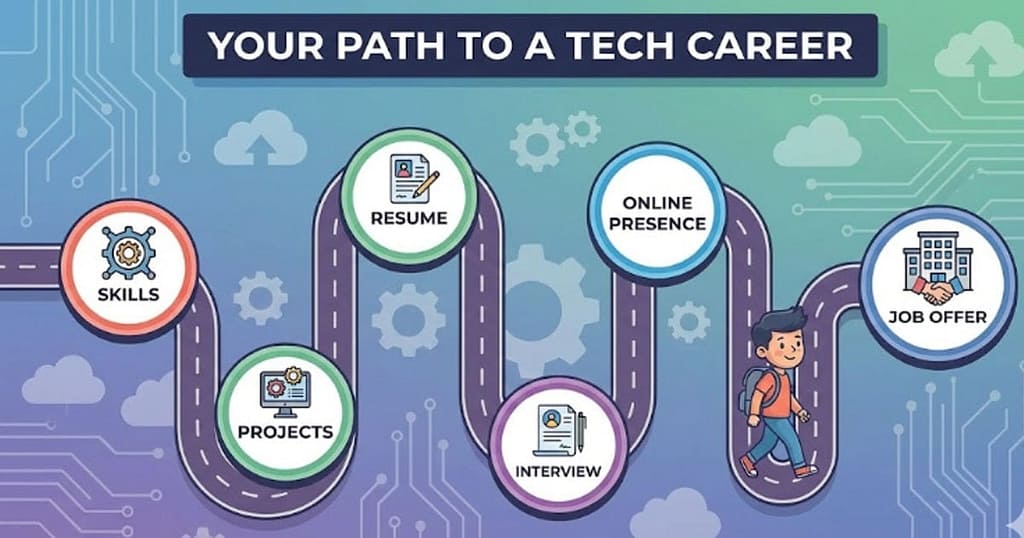
First tech jobs are not easy because companies need experienced candidates, and for a fresher, how will you get the experience? So here I will tell you all the tricks to crack your first job.
1. What Experience Companies Need
Experience doesn’t always mean company experience If you have projects with skills and a problem-solving mindset, then this also counts as experience, as now companies don’t want to train you. Companies expect freshers that if they join the company, then from the first day they contribute to the company project. So before joining, they take many rounds of test interviews before hiring you.
If you have any achievements on coding platforms like LeetCode, GFG, CodeChef, etc., it will also benefit you during interview or placement time. Hackathons and other tech experiences also matter.
So my suggestion to all students who are in college is to focus on skills by making projects and joining hackathons because this will benefit you in the future. Recruiters actually look for this experience from freshers.
2. Choose the Right Tech Role for Beginners
Entry-Level Tech Jobs:
Web Developer (Frontend/Backend)
Java Developer / Python Developer
QA/Software Tester
Data Analyst (Beginner)
IT Support / Technical Support
3. Learn In-Demand Skills (Smart Way)
Core Skills to Focus On:
Programming fundamentals
Problem-solving & logic
Git & GitHub basics
Databases & APIs
Best Free Learning Platforms:
YouTube: The best platform to learn for free is YouTube, where you can master skills without any cost. YouTube has every course for free to learn and practice.
FreeCodeCamp and Coursera (free courses): This platform offers free and paid courses to learn with certification, which you can add to your resume.
Documentation & blogs: This is the official documentation to help learn the new update about the framework language, and the blog is written by a technical expert so that you can learn from their experience.
4. Build Real Projects
Why do projects beat certificates? Projects beat certificates because projects show your real skills with hands-on experience. On buying the course, you can complete the course and earn a certificate, but in the project, you have built the project with your knowledge, which adds the real experience.
Project ideas for beginners:
Calculator / To-Do App
Portfolio website
Mini CRUD application
- Host your full-stack project frontend and backend with a database. Also, give yourself knowledge about deployment or push your code on GitHub; that will help you in showing code and live demos.
5. Resume Tips:
- Make a resume based on skills that highlight your project work with achievements and a short introduction of yourself. The format of the resume should be simple without a table. and follow a pattern like where to write skills, projects, education, profile summary, etc., which gives you a good impression.
- As today The resume is not selected manually; it is selected by the ATS (Applicant Tracking System) score. So after creating a resume, check your resume’s ATS score. If it is more than 85+, then it is ok. To check if it is ATS-friendly or not, click here
And for applying for a job, change your resume according to the job description as mentioned on the job portal. This increases your chance of resume shortlisting.
6. Build an Online Presence
- In today’s life, online presence is very important The Hindi proverb “Jo dikhta hai, wahi bikta hai” means if you show off your skills and achievements, then companies will reach out to you instead of you reaching out to companies.

- The platforms to showcase your skills are LinkedIn, where you can make real connections to industry experts and post your achievements, and maintaining a GitHub profile, where you push your code and contribute to other projects.
Personal portfolio website This is an optional but powerful way to showcase your skills to the real world, and if you want, then comment, and I will share my own portfolio.

7. Where to Apply
LinkedIn
Indeed
Company career pages
Internships & apprenticeships
These are the most common websites to apply for beginner-role jobs.
Apply for jobs as much as possible. Applying more increases your chance of selection.
8. Crack Interviews as a Fresher
From a fresher candidate, the company doesn’t ask difficult questions, as they also know you are just a beginner in this tech field; they only want from you that—
- You know about the fundamentals and related questions, which you can explain to him.

Explain the projects confidently that you have done. Why have you done this? What problem did you solve? Tech used in this?
They also check Behavioral & communication skills
9. Mistakes to Avoid:
- Don’t learn too many skills at once because while you try to multitask, you can’t complete anything, which results in wasted time, so the perfect path is to learn a tech and create a project.
- Don’t follow your friend’s skills as if, if your friend starts new tech, then you also start.
Conclusion
Getting your first job is not too hard, as people think; it is just a mind game to crack the job. Sometimes people don’t have skills but get a job just by confidence and communication skills.
Getting a job is about mindset, confidence, consistency, and smart preparation.
So stay focused, keep building projects, and believe in yourself; these are the key points for success.
Related Blog:
- What is Java?
- OOPs in java
- Tech Skills That Can Increase Your Salary in 2026
- AI Tools for Developers 2026
- Best Tech Skills That Generate Passive Income in 2026
- New Rule for IT Jobs in 2026 May Affect Fresher Hiring in India
Discover more from GroWithMoney
Subscribe to get the latest posts sent to your email.
Pingback: AI Tools for Developers 2026: Powerful Smart Picks
Pingback: 10 Top IT Companies Hiring Freshers– Eligibility, Salary
Pingback: TCS NQT 2026 Interview: My Real Experience & Mistakes
Pingback: What is Java? Why Java is Popular in 2026