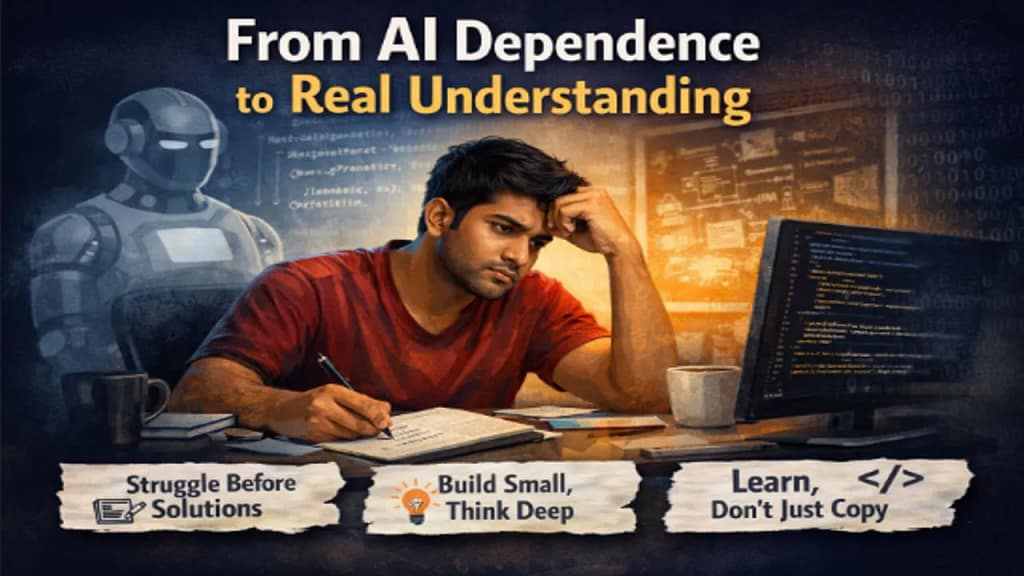
There was a time when Java made sense.
At least, I thought it did.
Then I opened a blank editor.
No hints.
No AI.
Just me and a problem statement.
My mind went empty.
Not because I didn’t study.
But because I realized something painful—I had seen the solution many times, but I had never owned it.
That moment stayed with me.
Where I’m Coming From
I’m a CS/IT fresher preparing for interviews in India.
I know the basics.
I’ve watched the tutorials.
I’ve solved questions.
I’ve even completed a few Java projects.
On paper, everything looks fine.
But inside, there’s always this quiet fear —
“What if they ask me to write code without help?”
And honestly, that fear didn’t come from nowhere.
Why Did Java Start Feeling Heavy?
Java didn’t become hard suddenly.
It happened slowly.
I started forgetting syntax.
Not the big concepts—the small things.
How to define a class.
How to loop properly.
Which collection to use and how to declare it.
And when I tried to build projects, everything felt too big.
Too many files.
Too many decisions.
Too many errors at once.
I didn’t feel dumb.
I felt tired.
Found AI Tools for Java
Like most freshers, I found ChatGPT.
At first, it felt magical.
I would paste a DSA problem.
It would generate clean Java code.
Perfect indentation.
Correct logic.
I told myself,
“I understand this.”
I really believed that.
Mistakes During Solving DSA

During DSA practice, my routine became lazy.
Problem → Ask AI → Read code → Nod head → Move on.
In my mind, I understood the logic.
I could explain it while reading.
But the real test came later.
I revisited the same problem after a few days.
And I couldn’t solve it.
Not even start it.
That’s when it hit me —
I wasn’t learning logic.
I was recognizing patterns.
And in the Infosys test, I perfectly realized that.
And recognition is not the same as understanding.
Why AI Code Felt Right But Failed Later
AI-generated Java code looks confident.
It doesn’t hesitate.
It doesn’t make silly syntax mistakes.
It doesn’t panic.
But I do.
And when I copied code, my brain skipped the hard part.
The part where confusion happens.
The part where mistakes teach you something.
AI removed the struggle—and along with it, the learning.
The Silent Damage of Copy-Paste Learning
The worst part wasn’t wrong output.
It was false confidence.
I thought I was improving.
But actually, I was becoming dependent.
In interviews, there’s no “regenerate response” button.
They don’t ask,
“Have you seen this code before?”
They ask,
“How would you solve this?”
And that difference matters.
Java Projects Made This Even Clearer
When I worked on projects, I used AI even more.
Because projects are messy.
You don’t know:
Where to start
What structure to follow
How many classes you need
AI helped me generate files quickly.
But when something broke, I was lost.
Because I didn’t build it—I assembled it.
That’s a big difference.
Emotional Truth
I realized I was scared of being slow.
Others were solving more problems.
Posting achievements.
Building projects faster.
AI helped me keep up.
But speed without depth is dangerous.
It feels productive.
Until it’s tested.
I Didn’t Stop Using AI—I Changed How I Use It
This is important.
I didn’t delete AI tools.
I didn’t decide “AI is bad ”.
That would be fake.
Instead, I changed one thing.
I stopped asking for the full code first.
That changed everything.
How to Use AI for Java 

When I face a DSA problem:
I first write something.
Even if it’s wrong.
Even if it doesn’t compile.
Then I ask AI things like
“Is my approach correct?”
“Why does this logic fail?”
“Explain this part in simple terms.”
Sometimes I ask for pseudocode, not Java code.
Only after I struggle do I look at full solutions.
That struggle matters more than the answer.
Syntax Forgetting Is Normal
I used to feel ashamed of forgetting syntax.
But syntax is not logic.
Java syntax comes back with repetition.
Logic only comes with thinking.
Now, when I forget syntax:
I don’t panic
I quickly check and continue
Interviews don’t reject you for missing a semicolon.
They reject you for not thinking clearly.
Projects Don’t Need to Be Big
Another mistake I made.
I thought good projects must be complex.
Spring Boot.
Microservices.
Too many layers.
But big projects hide weak understanding.
Small projects expose it.
Now I try to build:
One feature at a time
One class with responsibility
Code I can explain fully
If I can explain it, I own it.
Where AI Helps Genuinely
I won’t lie—AI helps.
It helps me:
Generate boilerplate faster
Understand error messages
Refactor messy code
Learn alternate approaches
Used this way, it feels like a senior guiding me—not replacing me.
I still use platforms like LeetCode and ChatGPT, but differently now.
Less copying.
More questioning.
A Soft Truth for Interviews
Interviewers can sense memorized code.
They don’t expect perfection.
They expect thought.
If AI is your shortcut, they’ll know.
If AI is your tool, you’ll show it naturally.
There’s a difference.
What I Wish I Knew Earlier
I wish someone had told me this:
Struggling is not failure.
It’s data.
Every time you’re stuck, your brain is working.
AI should reduce wasted effort, not thinking effort.
Once I understood that, learning felt lighter.
A Quiet Ending
I’m still a fresher.
Still preparing.
Still nervous.
I still forget syntax sometimes.
I still open AI tools.
But now, I know what I’m doing.
I’m not chasing speed anymore.
I’m chasing clarity.
And honestly, that feels enough for today.
Discover more from GroWithMoney
Subscribe to get the latest posts sent to your email.
Pingback: Low Code No Code in 2026: Build AI Tools Without Coding